Showing posts with label Rome. Show all posts

Missing details of an Ancient World in Second LIfe (Part. 2) - "Tota Pomarium Videatur"

Salvete Omnes.
As announced in the previous post, we're already talking about historical mistakes findable on ancient lands of Second Life.
In this chapter we'll discuss about a very less considered aspect: food sold into ancient Roman markets. Venturing in any of theese land's markets, it's possible to see how offered products are almost the
same:

... Have you ever wondered if products exposed in those markets are appropriate to the historical environment surrounding it?
There's to know that a significant part of the ancient Greeks and Romans' nourishment consisted of vegetables, roots, but also wild or cultivated fruits. Fruits were a great asset in the empire, and were consumed both local and foreign resources.
As you have seen in previous pictures, these stalls are full of fruits and vegetables; some of these foods, however, were not yet known by the Romans. Let us examine a few.

- TOMATO: a native fruit from Mexico and the high valleys of the Peruvian Andes, whose name comes from "Nahuatl" (Aztecs language) and it's pronounced "tomatl or jitomate",  arrives in Europe with the return to Spain of Christopher Columbus from the Americas. At first, it's considered poisonous so it's used as an ornamental plant; in the Sixteenth century it's used for the first time in kitchen in Italy.            - CORN, whose name comes from the language spoken by the Indians from Haiti, was cultivated for a long time on the new continent. About a thousand years B.C. Hopi's ancestors (southwest of the USA) grew of considerable corn's extensions, with which they obtain a paste used to prepare the "Tortillas". It was in fact the staple food of millions of American Natives, as well as most of them attributed it a divine origin. Starting from 1600, corn gradually replaced millet's cultivations in southern Europe; it's first used as basical feeding for animals, and the first using it in the kitchen are Basque people.
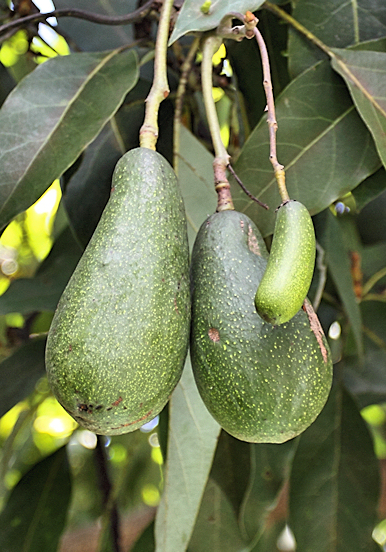
Avocados fruits
- AVOCADO, cultivated and consumed in Mexico since 5000 B.C. by the Aztecs, who called him "ahuacatl" (hence the Spanish "aguacate" or the Portuguese "abacate"). The fruit's transplant in the old continent, tried in the second half of the sixteenth century, near Rome, will prove a failure. We must wait the early 20thy century to let the avocado find its stable place in Europe.    - The PEPPER, perennial herb, is native to Central America. It was used to accompany meat dishes with red beans and corn, but was also used as an aromatic drug: the "chili", discovered by Columbus and the Spaniards and brought to Spain in the mid-sixteenth century, where it was used to enhance tomatoe's flavor. Then it's brought to Italy where it is called "coral horn", and very quickly to the rest of Europe, obtaining a spectacular success in Hungary, where it's setted up a sweeter mix: the famous "Paprika". 
- The POTATO, an herbaceous perennial plant, coming from central - southern America and imported for the first time in Europe in 1533, after Columbus' discoveries. From 1600 it becomes a common culture throughout Europe and it's used mostly for livestock nutrition. During the 1700s, known its high nutritional properties, it is consumed by all Europeans.

 In addition to pre Colombian food, we may also find kinds of products imported from Asia or Africa, not yet known by the Romans. Below we analyze some:
- The EGGPLANTS, native from India. They grown in Southeast Asia since prehistorical times and were introduced in Europe by Arabs in the early 4th century A.D.

Eggplants
- The BANANA, contrary to what might be tought, has origins in the highlands of 'South-East Asia, in Papua New Guinea, Malaysia and Philippines territories. Recent archaeological studies supports the existence of the first wild specimens of this fruit date back to 5000 BC. The first organized banana's crops dates back to 200 A.D. in China territories. In 650 A.D. Islamic conquerors exported this fruit in Palestine; later, Arab merchants brought it to almost the whole Africa. Around 1500, banana plant was introduced from Africa to the Caribbean and Central America by portugueses, then imported (only at that time) in Europe.
- The WATERMELON seems to have origins in the Kalahari desert. There are reports of first crops thanks to some Ancient Egyptian hieroglyphics dating back to 5000 years ago, when the fruit was often placed in pharaohs tombs as a means of sustenance for the afterlife. In the 10th century A.D. watermelon was cultivated in China and it was introduced in Europe only in the 13th century, with the Moors invasion.
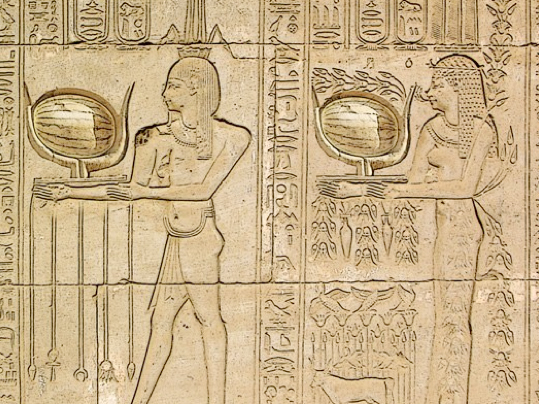
Egyptians used to place watermelons into pharaoes tombs in the way they could be fed of it in the afterlife
 So, what did ancient Romans eat?
As anybody, Romans were looking for new importing foods from every side of the world, experimenting and inventing new recipes with new ingredients. They also sought to graft and improve kinds of fruit trees, always inventing new varieties which unfortunately has been largely lost.Food for the Romans wasn't just a curiosity but a passion. There was any Roman taking care of his profession only. A great general could be a writer like Pliny, or an art collector as Maecenas, or an architect as Agrippa, or grafting fruit to invent a new product, which moreover would bear his name; for example Pliny the Younger mentions a pira (pear) Dolabelliana, (which has belonged to Publius Cornelius Dolabella 69-43 BC), or the pira Decimiana (perhaps of a certain Decinianus of the gens Claudia) or even the mala Mattiana, whose name comes from the botanical Caius Matius Calvena, known for his friendship with Julius Caesar and Cicero. The meat was rare food, at least for the poor class but also for the middle class. 
Below is a list of the most consumed foods by the Romans.
- BERRIES, considered fruits by the Romans. They include:
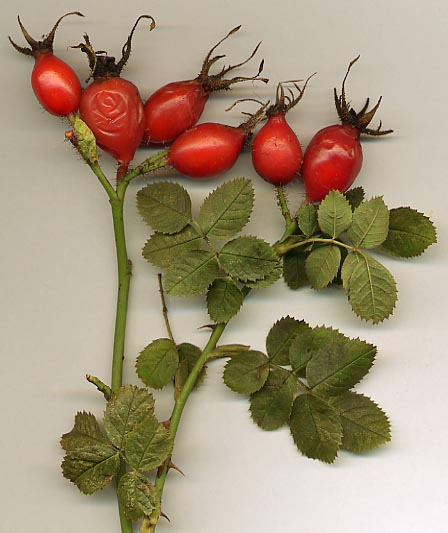
Rosehip
The ROSE (ie its rosehip), considered nutritious and healing (as rich of C vitamin). From it were obtained sauces for salty foods, sweets or velvety to eat alone or to garnishing cakes, or dissolved in water with other flower essences to make fresh drinks; the petals, however, combined with honey and other essences could become a fine food.
The BLACKBERRY (Rubus), used with honey and essences for bittersweet kitchens;
The RASPBERRY (Rubus), similar to blackberry as flavor but more acidic, was very used for fresheners or to stuff roasted sprayed with red and full-bodied wines;
 
The WILD PRUGNOLO or PRUNO (prunus), a spontaneous thorny plant of Europe, Asia, and North Africa; its sour taste and aromatic fruits were much appreciated by the Romans when eaten fresh or cooked with honey; by the same fruits was made a full of tannin vinegar (used instead of lemon, which was known but used as a medicine) that gave a sour taste to the foods;
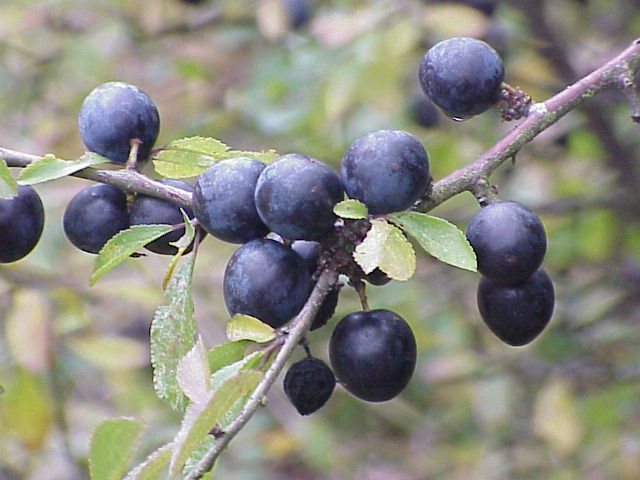
Prunus
The STRAWBERRY (Fragaria), particularly suitable for volcanic territories (as the Italic soil was), was much appreciated by the Romans; wealthy people owned it in crops, however it was not so difficult to find it in the undergrowth;
The PINE (Pinus), or the Pine berries (from whose white bark was also extracted a little tasty but nutritious meal), which were first used as dry fruit, to flavor meat or fish, or were mixed with honey or boiling molasses to make cakes;
the ACORN, the oak's fruit, from which was made a flour, after having purified it from tannin;

Corniola
 The CORNIOLA (corna), a red cherry-like fruit, from the aromatic, harsh and bitter flavor; it was first used to feed pigs, then he came introduced in Roman cooking; marinated in salt water for a certain period and seasoned with bay leaves and fennel seeds, was used to season the game's filling or red meat in general, or to prepare bitter-sweet sauces, or more was made a syrup diluted with water and served as a sorbet, to prepare the diners' stomach to the new dishes. It was also used as an ingredient to prepare puddings, uniting him to less acidic fruits such as pears, apples, and elder;
JUNIPER berries, similar to plums for their small rounded appearance, they were collected in autumn and left to dry in a ventilated place to then collect them in pots and use them throughout the year; They were used in roasts and in very tasty and spicy fillings, with fennel and thyme, and were good for strong and dry red wines;The CHASTE TREE (Vitex agnus-castus), a plant that usually grows on all Mediterranean and West Asia coasts, until Persia. Its bitter tasted fruits were eaten by Roman gourmets, combined with jujube or honey, or were used in desserts and soups, for its slightly spicy flavor.

- The DRY FRUIT, among which we list:
  The WALNUT (Juglans regia), plans of the Eastern Mediterranean, also known to the 
  Greeks;  the Romans cultivated it since the time of kings, using it in different ways like  
  throwing nuts during weddings or in the secret rites of Diana Caria monastery's priestess
  in Benevento, where the walnut tree's fruit was sacred. Varro, Pliny and Dioscorides talked 
  about walnuts.
  The ALMOND (amygdala), native to the Western temperate Asia, eaten by Greeks and 
  Romans, both sweet and bitter, it was believed that eaten before drinking wine could 
  prevent the thrill; used in different traditional Mediterranean kitchens like those of Sicily  
  and Puglia,  it accompanied sweet and savory dishes, or was served along with luscious 
  fruits;
  The PISTACHIOS (pistacia), came from the East, were mixed with some Roman kitchen 
  dishes;
- FLESHY FRUIT, among which we mention:
  The FIG (ficus), native from Caria in Asia Minor; much appreciated if eaten cool or dry, 
  it formed the most used occasional nourishment during the day; especially in Campania, 
  the Romans were very fond of eating bread and figs; it was considered also sacred,  
  because when unriped it produced a liquid similar to milk, so sacred to the goddess 
  Rumina, ancient pre-Roman and Roman goddess;
  the APPLE (malum), not a fruit but a knob, where the real fruit is the core, while the
  edible part is the core's receptacle; Romans ate it both raw and cooked, sweetened with  
  honey or molasses; It was mainly used by lower classes for the ease in cultivating and 
  storing it;
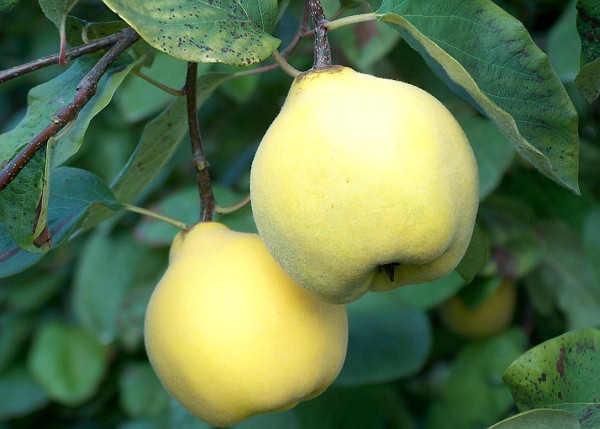
Malum Cotoneum
  The APPLE QUINCE (malum     
  cotoneum), considered by 
  Romans a sacred fruit to  
  Aphrodite;  there were  
  different qualities but few 
  were  suitable to be eaten raw;
  they were generally boiled  
  with honey or molasses and  
  combined with almonds and 
  walnuts, or was made  a kind 
  of jam which were
  manifactured sweets and  
  cookies;
  THE MALUM MUSTERIUM, made from a 
  quince graft with common apple, obtaining a
  variety very appreciated by the Romans; tasting slightly sour but compact, it had the
  advantage to keeping for a long time so was used as dried fruit or as an interlude or to
  manufacture sweets;
  The PEAR (pirum), present among the Romans in several different quality; such as the 
  apple, it  was eaten raw and cooked and was useful to make special dishes; pears could 
  be well preserved and dried in the sun and eaten boiled in wine.
  The MEDLAR (Mespilus germanica), known by the Romans after the Cato period and were 

  native from Germany and not Japan; differently than japaneses, those eaten by the 
  Romans  were sour and hard, in fact before being eaten they were sweetened by storing 
  them in a dry and well ventilated area;
Sorbs
The SORBS, mentioned by Hippocrates as an astringent medicine; their pulp was dried and sometimes mixed with 
wheat flour, to  make bread or tasty buns;
PEACH (persicum), native to China, spread throughout the Mediterranean hollow thanks to Alexander the Great and arrived in Rome in the 1st century D.C., it was first a reserved fruit for the riches, then it was spread out to all the tables;
The APRICOT (Prunus), originally from northeastern China to the Russian border and discovered by Alexander the Great in his travels in Persia, were the Romans who brang it not only in Italy but also in Greece, between 70-60 B.C.; often it was dried in the sun to enjoy it in those long periods when production was off;
The POMEGRANATE, considered native from South West Asia, has been cultivated in the Caucasus since ancient times and was spread by Phoenicians and Greeks in their colonies;
Lotus (Jujube)
The JUJUBES (lotus), native to Asia but already present in Italy since the time of Romans, were eaten fresh or withered, the withered one was often drowned in wine (making the so-called jujube' stock);
The PLUM (cereal prunum), known in many varieties, was anciently used and widely practiced; Greek doctors suggested to cook it with honey, for its laxative properties;
CHERRY (Prunus avium), whose first trees were imported to Rome in 72 B.C. by Lucius Licinius Lucullus after the firm of Mithridates;
The DATE (palmulae), used as exotic fruit imported from abroad;
The OLIVE rarely eaten fresh as a dessert fruit, while at times was eaten the fruit of persea, which was a plant still not well identified;

The CAROB, initially considered harmful for health, fell within recipts of some sweets where it was combined as powder with honey and crushed nuts, drawing an exquisite flavor;
The GRAPE, for the ancients one of the main dessert fruit; there were several varieties and were very appreciated both fresh and dried;
The ELDER, eaten as a fruit but with a special treatment;
The ARBUTUS, not so used in Rome except to make sauces and desserts; 
The CHESTNUT, known under different names, was eaten boiled, roasted, dried, cooked with fennel or in puree or soup; chestnuts also drew the flour;

And last, but not least, we find the CUCURBITS, including PUMPKIN, the CUCUMBER and POPON, native from Iran and used since the 5th century. B.C.

However, there is a fruit which recent discoveries has created a light "quid pro quo" (misunderstandings). In the Museum of Palazzo Massimo alle Terme in Rome, you can make an incredible discovery: at the second-floor, in the classic world's  frescoes, mosaics and stucco's gallery, there is a mosaic dated to the early 1st century A.D., showing a fruit basket containing from left, some figs, quince, a bunch of black grapes, pomegranates and an impossible food: a pineapple. The presence of this fruit has left speechless, because the Pineapple sativus plants, which belongs to the bromeliad family, arrived in the old Continent only after the Christopher Columbus' voyages. So before the American discovery, Romans could not know this tropical fruit.
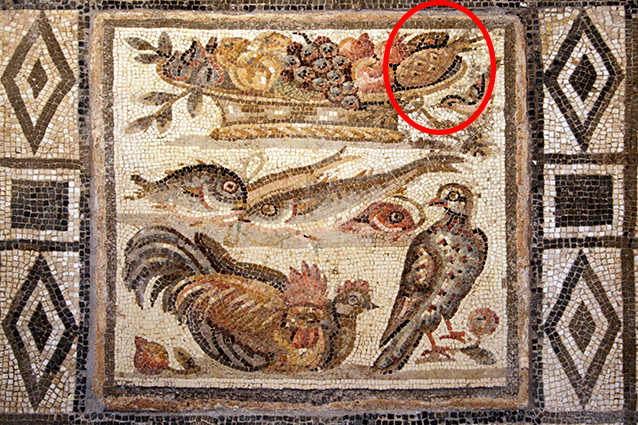
Actually it is not the first time a similar figure may be seen on a Roman work; a fresco found in the ephebe house in Pompeii shows a pineapple and a Roman statue, preserved in Geneva, representing a child holding a pineapple for its crest.

Everything suggests that Romans knew this fruit since the 1st century A.D. and this mystery has pioneered several hypotheses, including one that Romans could have arrived in America. Myth bustered right away, as the innumerable sources doesn't minimally referr to the New Continent, as it is certain their logistic capabilities would not allow them to reach so far places and above all beign able to stow fresh food for too long periods. It 's more likely that Romans have imported this fruit from West Africa, where pineapple was grown.So, let's hope this "virtual excursus" between the Roman food has made clear about ancients culinary habits. For a virtual roleplay land where knowing how to role play is the main pourpose, a touch of authenticity in these things would not hurt, indeed the game would result more interesting; in this sense builders and marketplace sellers play a main role, as people trust them and their creations to make spectacular and also authentic backgrounds. 
I wish you all a nice Ancient SL and see you to the next post!

 Hermes (a.k.a. Tonio Renfold).

Ancient Heritage on virtual grids: missing details of Ancient Worlds in Second Life (Part 1)

The metaverse is a really interesting world, which offers various ways to concretely represent what we can't bring in the real world. Between the many popular activities, both on the web (such as forums, blogs, social networks, etc ..) and in virtual grids like Second Life, we find the Roleplay, proposed in different scenarios: from fantasy to sci-fi, or those inspired by fictions and films, but also based on historical events or settings.
And it is right in historical scenarios that we focus our attention.
In the virtual world of Second Life, these scenarios are identified as belonging to the so called AW (acronymus for Ancient World), whose historical periods vary by Hellenistic age to the Victorian, through the various Mediterranean and Mesopotamian settings, until Northeast European lands.
To make the game more intriguing and compelling, some lands  got insipired by mythological stories of the periods which they belong; while others are based on stories and characters of famous Hollywood films (such as Cleopatra, played by Liz Taylor, The Gladiator of Russell Crowe, 300 of Zack Shneider or the famous TV saga licensed HBO, Spartacus).
 Sometimes theese stories are so intriguing and surreal that often fall into banality, representing a very far past from what has been handed down by our ancestors and from what has been discovered over the centuries by many historians and professionists.


Getting more in details, the purpose of this page is just to keep clear the many historical inconsistencies foundable in theese lands (as in those films they are inspired at), paying particular attention to the many historic Roman lands existed in the metaverse.
Want to know more? Then be patient and let's wait to read th next topic. For now "Valete Omnes".

The Ancient Pagan Origins of Easter

Easter Sunday is a festival and holiday celebrated by millions of people around the world
who honour the resurrection of Jesus from the dead, described in the New Testament as having occurred three days after his crucifixion at Calvary. It is also the day that children excitedly wait for the Easter bunny to arrive and deliver their treats of chocolate eggs.Easter is a ‘movable feast’ which is chosen to correspond with the first Sunday following the full moon after the March equinox, and occurs on different dates around the world since western churches use the Gregorian calendar, while eastern churches use the Julian calendar. So where did this ‘movable feast’ begin, and what are the origins of the traditions and customs celebrated on this important day around the world?

Easter - Christianity

Resurrection of Jesus.

Most historians, including Biblical scholars, agree that Easter was originally a pagan festival. According to the New Unger’s Bible Dictionary says: “The word Easter is of Saxon origin, Eastra, the goddess of spring, in whose honour sacrifices were offered about Passover time each year. By the eighth century Anglo–Saxons had adopted the name to designate the celebration of Christ’s resurrection.” However, even among those who maintain that Easter has pagan roots, there is some disagreement over which pagan tradition the festival emerged from. Here we will explore some of those.

Resurrection as a symbol of rebirth

One theory that has been put forward is that the Easter story of crucifixion and resurrection is symbolic of rebirth and renewal and retells the cycle of the seasons, the death and return of the sun.
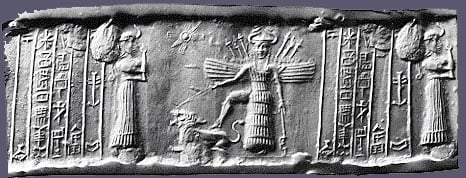
According to some scholars, the Easter story comes from the Sumerian legend of Damuzi (Tammuz) and his wife Inanna (Ishtar), an epic myth called “The Descent of Inanna” found inscribed on cuneiform clay tablets dating back to 2100 BC. When Tammuz dies, Ishtar is grief–stricken and follows him to the underworld. In the underworld, she enters through seven gates, and her worldly attire is removed. "Naked and bowed low" she is judged, killed, and then hung on display. In her absence, the earth loses its fertility, crops cease to grow and animals stop reproducing. Unless something is done, all life on earth will end. After Inanna has been missing for three days her assistant goes to other gods for help. Finally one of them Enki, creates two creatures who carry the plant of life and water of life down to the Underworld, sprinkling them on Inanna and Damuzi, resurrecting them, and giving them the power to return to the earth as the light of the sun for six months. After the six months are up, Tammuz returns to the underworld of the dead, remaining there for another six months, and Ishtar pursues him, prompting the water god to rescue them both. Thus were the cycles of winter death and spring life.

The Descent of Inanna
The Descent of Inanna.

The drawing parallels between the story of Jesus and the epic of Inanna “doesn't necessarily mean that there wasn't a real person, Jesus, who was crucified, but rather that, if there was, the story about it is structured and embellished with a pattern that was very ancient and widespread.
The Sumerian goddess Inanna is known outside of Mesopotamia by her Babylonian name, "Ishtar". In ancient Canaan Ishtar is known as Astarte, and her counterparts in the Greek and Roman pantheons are known as Aphrodite and Venus. In the 4th Century, when Christians identified the exact site in Jerusalem where the empty tomb of Jesus had been located, they selected the spot where a temple of Aphrodite (Astarte/Ishtar/Inanna) stood. The temple was torn down and the So Church of the Holy Sepulchre was built, the holiest church in the Christian world.
The story of Inanna and Damuzi is just one of a number of accounts of dying and rising gods that represent the cycle of the seasons and the stars. For example, the resurrection of Egyptian Horus; the story of Mithras, who was worshipped at Springtime; and the tale of Dionysus, resurrected by his grandmother. Among these stories are prevailing themes of fertility, conception, renewal, descent into darkness, and the triumph of light over darkness or good over evil.


Easter as a celebration of the Goddess of Spring

Rather than being a representation of the story of Ishtar, Easter was originally a celebration of Eostre, goddess of Spring, otherwise known as Ostara, Austra, and Eastre. 
Celebrated at Spring Equinox on March 21, Ostara marks the day when light is equal to darkness, and will continue to grow. As the bringer of light after a long dark winter, the goddess was often depicted with the hare, an animal that represents the arrival of spring as well as the fertility of the season.
The idea of resurrection was ingrained within the celebration of Ostara: “Ostara, Eástre seems therefore to have been the divinity of the radiant dawn, of upspringing light, a spectacle that brings joy and blessing, whose meaning could be easily adapted by the resurrection-day of the christian’s God.”
Most analyses of the origin of the word ‘Easter’ maintain that it was named after a goddess mentioned by the 7th to 8th-century English monk Bede, who wrote that Ēosturmōnaþ (Old English 'Month of Ēostre', translated in Bede's time as "Paschal month") was an English month, corresponding to April, which he says "was once called after a goddess of theirs named Ēostre, in whose honour feasts were celebrated in that month".


The origins of Easter customs

The most widely-practiced customs on Easter Sunday relate to the symbol of the rabbit (‘Easter bunny’) and the egg.  The rabbit was a symbol associated with Eostre, representing the beginning of Springtime. Likewise, the egg has come to represent Spring, fertility and renewal.  In Germanic mythology, it is said that Ostara healed a wounded bird she found in the woods by changing it into a hare. Still partially a bird, the hare showed its gratitude to the goddess by laying eggs as gifts. Another document about the pagan traditions associated with the egg,   clearly explains: “The egg as a symbol of fertility and of renewed life goes back to the ancient Egyptians and Persians, who had also the custom of colouring and eating eggs during their spring festival.” In ancient Egypt, an egg symbolised the sun, while for the Babylonians, the egg represents the hatching of the Venus Ishtar, who fell from heaven to the Euphrates.

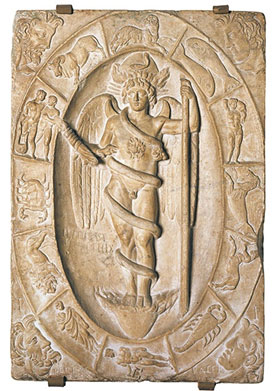
Relief with Phanes
2nd century A.D. Orphic god Phanes emerging from the cosmic egg, surrounded by the zodiac.


In many Christian traditions, the custom of giving eggs at Easter celebrates new life. Christians remember that Jesus, after dying on the cross, rose from the dead, showing that life could win over death. For Christians the egg is a symbol of Jesus' resurrection, as when they are cracked open, they stand for the empty tomb.
Regardless of the very ancient origins of the symbol of the egg, most people agree that nothing symbolises renewal more perfectly than the egg – round, endless, and full of the promise of life.
While many of the pagan customs associated with the celebration of Spring were at one stage practised alongside Christian Easter traditions, they eventually came to be absorbed within Christianity, as symbols of the resurrection of Jesus.  
The First Council of Nicaea (325) established the date of Easter as the first Sunday after the full moon (the Paschal Full Moon) following the March equinox.
Whether it is observed as a religious holiday commemorating the resurrection of Jesus Christ, or a time for families in the northern hemisphere to enjoy the coming of Spring and celebrate with egg decorating and Easter bunnies, the celebration of Easter still retains the same spirit of rebirth and renewal, as it has for thousands of years.


---------------------------------------------------------------------------------------------------------------------
Original source by
The ancient pagan origin of Easter - Ancient Origins

References
The pagan roots of Easter - Heather McDougall
The Origins of Easter – by Ross Abasolo

Hermes, the Numidian

My true name is Juba'aal and I come from the land of Numidia, which the Romans called Africa Nova ... just like they do with me, calling me Hermes.
I'm a rudiarius, retired from the games when I gained the Rudis, and also a libertus, thanxgiving Domine Notorious Felonis, wich granted me the manumissio after all my efforts. After a while I left Sicily venturing in the Empire, till the capital, where my troubles began. I've been  accused of embezzlement and sentenced to exile on an island geographically halfway between two worlds that belonged to my past: the island of Melita. Here I continued to exercise my job of lanista to entertain the few Roman citizens who passed or settled in the island, paying my debts with part of the wins.
Once my exile was done, I sadly left the island of Melita with my Familia Gladiatoria, looking for new scenarios in which to sell shows, so I took the first ship to the Aegean Sea and I left Melita for the Dodecanese , a place for me unknowed.  Here I landed on the island of Lutho, where I was well received by the local population and the Quaestor, who gave me the authorization to prosecue my activities in this majest island.
Everithing seemed to proceed for the best...until that terrible day where the gods, Vulcanus first, exploded their anger on that small island. All around was a mix of ash and debris. Many survivors, within many inn roman citizens, could leave the island taking the big roman cargo moored in the harbour and soon diverted to Pergamus. Beh, many except me: a voice into my mind suggested me to not follow them and that I could reach my fortune again elsewhere. So i left that island on a fishing boat, heading to another island, and one more; everyday on a different one, until landing in Rhodes.
There an unexpected meeting with an his old knowledge, gave him the opportunity to move back to Roma and there to work again as lanista for the biggest gladiatorial school of all the empire.

Roman Warships pt. 1 & the Celeuma's Song

We know alot about this powerful means of conquest and control of the seas, especially with reproductions on coins, bas-reliefs, pompeian frescoes and historical descriptions, while the archaeological finds are limited in large measure to "navi onerarie" (cargo ships) and their loads.
The Roman warships were classified in:

naves praetoriae (flagships): long, rowing and very fast;


naves longae and naves liburnicae: very fast and with several rows of oars;

naves actuariae: read, for troops transportation;

naves speculatoriae: of reconnaissance, to observe the enemy;

naves tabellariae: small units for sending dispatches.

The type of ship is generally related to the orders of oars present on each of them.

Bireme
"navis longa" with two rows of oarsmen sitting on the same bench. It was also equipped of a square sail and developed a good speed thanks to its weight and small size. It was superseded by more
functional trireme.

Trireme 
"navis longa" with three series of rowers. It was the most commonly used warship, was equipped with a rostrum and, in newer units, there was a tower to house archers at bow to launch arrows from higher positions. At the aft was built cab blanket commander. Its crew was 200 men including 150 rowers and 15 between Officers and NCOs.

Gladius Romanus Formosus

Many reproductions of this type of weapon represent it with a special shape: wide at the tip, closer to the center and back to the same lar length near the hilt. May it be true?
From a field experience has been seen that sharpening costantly a sword with parallel edges to remove dents caused by the impact of other weapons, these are gradually shrinking at the center until they assumed that particular form. We might also think that for the Roman soldiers have a sword with this particular form was a source of pride in what could amount to having fought many battles and killed many enemies.

Gladius Romanus Formosus

Venus and Adonis

Venus, playing one day with her boy Cupid, wounded her bosom with one of his arrows. She pushed him away, but the wound was deeper than she thought. Before it healed she beheld Adonis, and was captivated with him. She no longer took any interest in her favorite resorts—Paphos, and Cnidos, and Amathos, rich in metals. She absented herself even from heaven, for Adonis was dearer to her than heaven. Him she followed and bore him company. She who used to love to recline in the shade, with no care but to cultivate her charms, now rambles through the woods and over the hills, dressed like the huntress Diana; and calls her dogs, and chases hares and stags, or other game that it is safe to hunt, but keeps clear of the wolves and bears, reeking with the slaughter of the herd. She charged Adonis, too, to beware of such dangerous animals. “Be brave towards the timid,” said she; “courage against the courageous is not safe. Beware how you expose yourself to danger and put my happiness to risk. Attack not the beasts that Nature has armed with weapons. I do not value your glory so high as to consent to purchase it by such exposure. Your youth, and the beauty that charms Venus, will not touch the hearts of lions and bristly boars. Think of their terrible claws and prodigious strength! I hate the whole race of them. Do you ask me why?” Then she told him the story of Atalanta and Hippomenes, who were changed into lions for their ingratitude to her.

Glaucus and Scylla

Glaucus was a fisherman. One day he had drawn his nets to land, and had taken a great many fishes of various kinds. So he emptied his net, and proceeded to sort the fishes on the grass. The place where he stood was a beautiful island in the river, a solitary spot, uninhabited, and not used for pasturage of cattle, nor ever visited by any but himself. On a sudden, the fishes, which had been laid on the grass, began to revive and move their fins as if they were in the water; and while he looked on astonished, they one and all moved off to the water, plunged in, and swam away. He did not know what to make of this, whether some god had done it or some secret power in the herbage. “What herb has such a power?” he exclaimed; and gathering some of it, he tasted it. Scarce had the juices of the plant reached his palate when he found himself agitated with a longing desire for the water. He could no longer restrain himself, but bidding farewell to earth, he plunged into the stream. The gods of the water received him graciously, and admitted him to the honor of their society. They obtained the consent of Oceanus and Tethys, the sovereigns of the sea, that all that was mortal in him should be washed away. A hundred rivers poured their waters over him. Then he lost all sense of his former nature and all consciousness. When he recovered, he found himself changed in form and mind. His hair was sea-green, and trailed behind him on the water; his shoulders grew broad, and what had been thighs and legs assumed the form of a fish’s tail. The sea-gods complimented him on the change of his appearance, and he fancied himself rather a good-looking personage.

Proserpine

When Jupiter and his brothers had defeated the Titans and banished them to Tartarus, a new enemy rose up against the gods. They were the giants Typhon, Briareus, Enceladus, and others. Some of them had a hundred arms, others breathed out fire. They were finally subdued and buried alive under Mount Ætna, where they still sometimes struggle to get loose, and shake the whole island with earthquakes. Their breath comes up through the mountain, and is what men call the eruption of the volcano.

The fall of these monsters shook the earth, so that Pluto was alarmed, and feared that his kingdom would be laid open to the light of day. Under this apprehension, he mounted his chariot, drawn by black horses, and took a circuit of inspection to satisfy himself of the extent of the damage. While he was thus engaged, Venus, who was sitting on Mount Eryx playing with her boy Cupid, espied him, and said, “My son, take your darts with which you conquer all, even Jove himself, and send one into the breast of yonder dark monarch, who rules the realm of Tartarus. Why should he alone escape? Seize the opportunity to extend your empire and mine. Do you not see that even in heaven some despise our power? Minerva the wise, and Diana the huntress, defy us; and there is that daughter of Ceres, who threatens to follow their example. Now do you, if you have any regard for your own interest or mine, join these two in one.” The boy unbound his quiver, and selected his sharpest and truest arrow; then straining the bow against his knee, he attached the string, and, having made ready, shot the arrow with its barbed point right into the heart of Pluto.

Baucis and Philemon

On a certain hill in Phrygia stands a linden tree and an oak, enclosed by a low wall. Not far from the spot is a marsh, formerly good habitable land, but now indented with pools, the resort of fen-birds and cormorants. Once on a time Jupiter, in human shape, visited this country, and with him his son Mercury (he of the caduceus), without his wings. They presented themselves, as weary travellers, at many a door, seeking rest and shelter, but found all closed, for it was late, and the inhospitable inhabitants would not rouse themselves to open for their reception. At last a humble mansion received them, a small thatched cottage, where Baucis, a pious old dame, and her husband Philemon, united when young, had grown old together. Not ashamed of their poverty, they made it endurable by moderate desires and kind dispositions. One need not look there for master or for servant; they two were the whole household, master and servant alike. When the two heavenly guests crossed the humble threshold, and bowed their heads to pass under the low door, the old man placed a seat, on which Baucis, bustling and attentive, spread a cloth, and begged them to sit down. Then she raked out the coals from the ashes, and kindled up a fire, fed it with leaves and dry bark, and with her scanty breath blew it into a flame. She brought out of a corner split sticks and dry branches, broke them up, and placed them under the small kettle. Her husband collected some pot-herbs in the garden, and she shred them from the stalks, and prepared them for the pot. He reached down with a forked stick a flitch of bacon hanging in the chimney, cut a small piece, and put it in the pot to boil with the herbs, setting away the rest for another time. A beechen bowl was filled with warm water, that their guests might wash. While all was doing, they beguiled the time with conversation.

On the bench designed for the guests was laid a cushion stuffed with sea-weed; and a cloth, only produced on great occasions, but ancient and coarse enough, was spread over that. The old lady, with her apron on, with trembling hand set the table. One leg was shorter than the rest, but a piece of slate put under restored the level. When fixed, she rubbed the table down with some sweet-smelling herbs. Upon it she set some of chaste Minerva’s olives, some cornel berries preserved in vinegar, and added radishes and cheese, with eggs lightly cooked in the ashes. All were served in earthen dishes, and an earthenware pitcher, with wooden cups, stood beside them. When all was ready, the stew, smoking hot, was set on the table. Some wine, not of the oldest, was added; and for dessert, apples and wild honey; and over and above all, friendly faces, and simple but hearty welcome.

Now while the repast proceeded, the old folks were astonished to see that the wine, as fast as it was poured out, renewed itself in the pitcher, of its own accord. Struck with terror, Baucis and Philemon recognized their heavenly guests, fell on their knees, and with clasped hands implored forgiveness for their poor entertainment. There was an old goose, which they kept as the guardian of their humble cottage; and they bethought them to make this a sacrifice in honor of their guests. But the goose, too nimble, with the aid of feet and wings, for the old folks, eluded their pursuit, and at last took shelter between the gods themselves. They forbade it to be slain; and spoke in these words: “We are gods. This inhospitable village shall pay the penalty of its impiety; you alone shall go free from the chastisement. Quit your house, and come with us to the top of yonder hill.” They hastened to obey, and, staff in hand, labored up the steep ascent. They had reached to within an arrow’s flight of the top, when turning their eyes below, they beheld all the country sunk in a lake, only their own house left standing. While they gazed with wonder at the sight, and lamented the fate of their neighbors, that old house of theirs was changed into a temple. Columns took the place of the corner posts, the thatch grew yellow and appeared a gilded roof, the floors became marble, the doors were enriched with carving and ornaments of gold. Then spoke Jupiter in benignant accents: “Excellent old man, and woman worthy of such a husband, speak, tell us your wishes; what favor have you to ask of us?” Philemon took counsel with Baucis a few moments; then declared to the gods their united wish. “We ask to be priests and guardians of this your temple; and since here we have passed our lives in love and concord, we wish that one and the same hour may take us both from life, that I may not live to see her grave, nor be laid in my own by her.” Their prayer was granted. They were the keepers of the temple as long as they lived. When grown very old, as they stood one day before the steps of the sacred edifice, and were telling the story of the place, Baucis saw Philemon begin to put forth leaves, and old Philemon saw Baucis changing in like manner. And now a leafy crown had grown over their heads, while exchanging parting words, as long as they could speak. “Farewell, dear spouse,” they said, together, and at the same moment the bark closed over their mouths. The Tyanean shepherd still shows the two trees, standing side by side, made out of the two good old people.

The story of Baucis and Philemon has been imitated by Swift, in a burlesque style, the actors in the change being two wandering saints, and the house being changed into a church, of which Philemon is made the parson. The following may serve as a specimen:

“They scarce had spoke, when, fair and soft,
The roof began to mount aloft;
Aloft rose every beam and rafter;
The heavy wall climbed slowly after.
The chimney widened and grew higher,
Became a steeple with a spire.
The kettle to the top was hoist,
And there stood fastened to a joist,
But with the upside down, to show
Its inclination for below;
In vain, for a superior force,
Applied at bottom, stops its course;
Doomed ever in suspense to dwell,
’Tis now no kettle, but a bell.
A wooden jack, which had almost
Lost by disuse the art to roast,
A sudden alteration feels.
Increased by new intestine wheels;
And, what exalts the wonder more,
The number made the motion slower;
The flier, though ’t had leaden feet,
Turned round so quick you scarce could see ’t;
But slackened by some secret power,
Now hardly moves an inch an hour.
The jack and chimney, near allied,
Had never left each other’s side:
The chimney to a steeple grown,
The jack would not be left alone;
But up against the steeple reared,
Became a clock, and still adhered;
And still its love to household cares
By a shrill voice at noon declares,
Warning the cook-maid not to burn
That roast meat which it cannot turn;
The groaning chair began to crawl,
Like a huge snail, along the wall;
There stuck aloft in public view,
And with small change, a pulpit grew.
A bedstead of the antique mode,
Compact of timber many a load,
Such as our ancestors did use,
Was metamorphosed into pews,
Which still their ancient nature keep
By lodging folks disposed to sleep.”

Midas

Bacchus, on a certain occasion, found his old schoolmaster and foster-father, Silenus, missing. The old man had been drinking, and in that state wandered away, and was found by some peasants, who carried him to their king, Midas. Midas recognized him, and treated him hospitably, entertaining him for ten days and nights with an unceasing round of jollity. On the eleventh day he brought Silenus back, and restored him in safety to his pupil. Whereupon Bacchus offered Midas his choice of a reward, whatever he might wish. He asked that whatever he might touch should be changed into gold. Bacchus consented, though sorry that he had not made a better choice. Midas went his way, rejoicing in his new-acquired power, which he hastened to put to the test. He could scarce believe his eyes when he found a twig of an oak, which he plucked from the branch, become gold in his hand. He took up a stone; it changed to gold. He touched a sod; it did the same. He took an apple from the tree; you would have thought he had robbed the garden of the Hesperides. His joy knew no bounds, and as soon as he got home, he ordered the servants to set a splendid repast on the table. Then he found to his dismay that whether he touched bread, it hardened in his hand; or put a morsel to his lips, it defied his teeth. He took a glass of wine, but it flowed down his throat like melted gold.

In consternation at the unprecedented affliction, he strove to divest himself of his power; he hated the gift he had lately coveted. But all in vain; starvation seemed to await him. He raised his arms, all shining with gold, in prayer to Bacchus, begging to be delivered from his glittering destruction. Bacchus, merciful deity, heard and consented. “Go,” said he, “to the River Pactolus, trace the stream to its fountain-head, there plunge your head and body in, and wash away your fault and its punishment.” He did so, and scarce had he touched the waters before the gold-creating power passed into them, and the river-sands became changed into gold, as they remain to this day.

Thenceforth Midas, hating wealth and splendor, dwelt in the country, and became a worshipper of Pan, the god of the fields. On a certain occasion Pan had the temerity to compare his music with that of Apollo, and to challenge the god of the lyre to a trial of skill. The challenge was accepted, and Tmolus, the mountain god, was chosen umpire. The senior took his seat, and cleared away the trees from his ears to listen. At a given signal Pan blew on his pipes, and with his rustic melody gave great satisfaction to himself and his faithful follower Midas, who happened to be present. Then Tmolus turned his head toward the Sun-god, and all his trees turned with him. Apollo rose, his brow wreathed with Parnassian laurel, while his robe of Tyrian purple swept the ground. In his left hand he held the lyre, and with his right hand struck the strings. Ravished with the harmony, Tmolus at once awarded the victory to the god of the lyre, and all but Midas acquiesced in the judgment. He dissented, and questioned the justice of the award. Apollo would not suffer such a depraved pair of ears any longer to wear the human form, but caused them to increase in length, grow hairy, within and without, and movable on their roots; in short, to be on the perfect pattern of those of an ass.

Mortified enough was King Midas at this mishap; but he consoled himself with the thought that it was possible to hide his misfortune, which he attempted to do by means of an ample turban or head-dress. But his hair-dresser of course knew the secret. He was charged not to mention it, and threatened with dire punishment if he presumed to disobey. But he found it too much for his discretion to keep such a secret; so he went out into the meadow, dug a hole in the ground, and stooping down, whispered the story, and covered it up. Before long a thick bed of reeds sprang up in the meadow, and as soon as it had gained its growth, began whispering the story, and has continued to do so, from that day to this, every time a breeze passes over the place.

The story of King Midas has been told by others with some variations. Dryden, in the “Wife of Bath’s Tale,” makes Midas’s queen the betrayer of the secret:

“This Midas knew, and durst communicate
To none but to his wife his ears of state.”

Midas was king of Phrygia. He was the son of Gordius, a poor countryman, who was taken by the people and made king, in obedience to the command of the oracle, which had said that their future king should come in a wagon. While the people were deliberating, Gordius with his wife and son came driving his wagon into the public square.

Gordius, being made king, dedicated his wagon to the deity of the oracle, and tied it up in its place with a fast knot. This was the celebrated Gordian knot, which, in after times it was said, whoever should unite should become lord of all Asia. Many tried to untie it, but none succeeded, till Alexander the Great, in his career of conquest, came to Phrygia. He tried his skill with as ill success as others, till growing impatient he drew his sword and cut the knot. When he afterwards succeeded in subjecting all Asia to his sway, people began to think that he had complied with the terms of the oracle according to its true meaning.

Contact Form

Name

Email *

Message *

 
Copyright 2007 Melita Insula