Gladiator: Etymology: Latin, from gladius sword
The Origins of the Gladiatorial Games
There is little evidence found to support the true origins of the gladiatorial games, however the Romans claimed that their tradition of gladiatorial games was adopted from the Etruscans. In contrast, the ancient Greeks also held games of combat, such as the funeral games honoring the fallen Patroklos as depicted in Homer's Iliad. In these games, the defeat of the atheletes was symbolic of death, whereas Roman gladiatorial combat ended in very real death.
The first known gladiatorial games, held in 310 BCE by the Campanians was written about by Roman historian Livy. These games symbolized the re-enactment of the Campanians' military success over the Samnites, in which they were aided by the Romans. The first Roman gladiatorial games were held in 246 BCE by Marcus and Decimus Brutus in honor of their father, Junius Brutus, as a munus, or funeral gift for the dead. It was a relatively small affair that included the combat of three pairs of slaves in the Forum Boarium (a commercial area that was named after the Roman cattle market). GladiatorsThe Romans called a gladiatorial contest a munus, that is, a duty paid by descendants to a dead ancestor. The munus served the purpose of keeping alive the memory of an important individual after death. Munera were held some time after the funeral and were often repeated at annual or five-year intervals. Gladiatorial fights were not incorporated into public games until the late first century.

Festus, a second century AD scholar, suggests that gladiatorial combat was a substitution for an original sacrifice of prisoners on the tombs of great warriors. There is an interesting parallel for this in Homer's Iliad: Achilles sacrificed twelve Trojan boys on Patroklos' tomb. This practice is most likely based on the idea that blood could restore life to the dead. For example, the ghosts in the Odyssey who come up out of the depths, attracted by the animal blood of animals slaughtered by Odysseus.
Tertullian, a second century AD Christian writer, claimed that gladiatorial combat was a human sacrifice to the manes or spirits of the dead (De Spect. 12.2-3). Ville supports this view of gladiatorial combat as a substitute for a human sacrifice that nourishes the honored dead with blood. He calls gladiatorial contests an amelioration of human sacrifice that permits at least the winner to survive the ritual — and sometimes even the loser.
Who Were the Gladiators
For the most part, gladiators were condemned criminals, prisoners of war, or slaves (especially captured fugitives) bought for the purpose of gladiatorial combat by a lanista (owner of gladiators). Gladiators Criminals, having lost their citizen rights and slaves and prisoners of war having none, had no choice about becoming a gladiator, if they had the physical and emotional make-up necessary for the profession.
However, there were professional gladiators — free men who volunteered to participate in the games, although they had not lost their citizen rights. These gladiators were known as auctorati (volunteers). As a gladiator, a man who had volunteered to be a gladiator, gained immediate status even though the gladiatorial oath forced him to act as a slave to his master and "to endure branding, chains, flogging, or death by the sword" (Petronius Satyricon, 117.5). Gladiators were required to do what their lanista ordered. In The Satyricon, Petronius suggested that Roman crowds preferred combat by free men over that of slaves. It has been estimated that by the end of the Republic, about half of the gladiators were volunteers who took on the status of a slave for an agreed-upon period of time. Interest ran so high, that the emperor Augustus sought to preserve the pietas and virtus of the knight class and Roman senate by forbidding them to participate in gladiatorial combat. It would be sometime later, when Caligula and Nero would order both groups to participate in the games.
Why such a high interest for a free man to become a gladiator, especially when upon taking the gladiator's oath, the man agreed to be treated as a slave and suffered the ultimate social disgrace infamia. Seneca describes the oath as "most shameful" (Ep. 37.1-2). There were advantages of being a gladiator, however. The gladiator's life held new meaning. He became a member of a cohesive group that was known for its courage, good morale, and absolute fidelity to its master to the point of death. Although being a professional gladiator made one low on the social scale, free men often found popularity and patronage of wealthy Roman citizens by becoming gladiators. His life became a model of military discipline and through courageous behavior he was also now capable of achieving honor similar to that enjoyed by Roman soldiers on the battlefield.
There were other advantages. In the arena, the volunteer gladiator could indulge his fantasy of military glory and fame before an admiring crowd. And women idolized these men. Donald Kyle points out other practical advantages of the gladiator's life: The living conditions of gladiators were harsh but, as profitable investments, they perhaps lived better than many commoners in terms of food, housing, and medical attention. New or undisciplined men were shackled and unattended only in the bathroom, but trained gladiators were not always bound, imprisoned, or even confined to barracks.
Public Opinion
In ancient Rome, heroes were often comprised of gladiators, especially during the years of peace under the Augustans in the first and second centuries. Gladiators could earn such idolized status as today's great atheltes enjoy. Although a gladiator's social status was just barely better than a slave, many Roman citizens, knights — even Roman emperors — fought in the gladiatorial arena because of their love of the sport and their desire for adoration and fame. Emperor Commodus boasted that he himself had fought in over a thousand gladiatorial duels. The Romans seemed ambivalent to the violent nature of the gladiatorial games and without war heroes, they needed someone to idolize. Thusly, this role fell to the gladiators.

The munerarius of gladiatorial games gained popularity among Roman citizens and generated political momentum in doing so. As an example, Julius Caesar in his grandiose way, commanded 320 ludi of gladiators to dual against one another in a wooden amphitheater constructed specifically for the event. Gladiator Although this was done under the auspices that the games were a munus for his dead father, it was more than likely a ploy for Caesar who was seeking political favor to assure his election as praetor.
There is plenty of evidence that Roman women especially idolized the gladiators — sometimes to the dismay of their husbands. It is mentioned that the mother of Emperor Commodus, Faustina, was to have preferred the gladiator Martianus over her husband, Marcus Aurelius. Eppia, a senator's wife, was said to have thought so highly of gladiators that she preferred them to her children, country, sister, and husband, per the writings of Juvenal, and ran off with her gladiator lover to Egypt (6.82 ff.). There is even an inscription on a wall in Pompeii that says the Thracian gladiator Celadus was suspirum et decus puellarum, literally "the sigh and glory of the girls." In other words, he was the beefcake of ancient Roman women.
It should also be noted that some emperors were swept away by gladiator mania, such as Caligula and Commodus. Both of these emperors actually appeared in the arena as gladiators (no doubt with opponents who were careful to inflict no harm). These two emperors were known to be mentally unstable and apparently felt no inhibitions in indulging their gladiatorial fantasies. At least seven other emperors of sound mind (including Titus and Hadrian) either practiced as gladiators or fought in gladiatorial contests.
Ownership and Training
Gladiators were owned by a person called a lanista and were trained in the lanista's school (ludus). Gladiatorial combat was as much a science as modern boxing. Training involved the learning of a series of figures, which were broken down into various phases. There were times in which fans complained that a gladiator fought too mechanically. In the early Empire, there were four major gladiatorial ludi, however, by this time, the training of gladiators had been taken over by the state, most likely because it was thought too dangerous to allow private citizens to own and train gladiators who could be easily turned into a private army . Therefore, with very few exceptions, gladiators were under the control and ownership of the emperor, although the lantistae continued to train and own gladiators outside of Rome. The lanistae often times made a profit by renting or selling the troupe, which proved to be a very lucrative business. The objections encountered were that these men derived their whole income from treating human beings like animals. An upper-class citizen could own and maintain his own troupe and even hire them out without suffering the scorn of his fellow aristocrats. The saving factor was that the citizen was a dabbler and not a professional: his main source of income did not derive from his ownership of gladiators. Auguet writes: In the eyes of the Romans he was regarded as both a butcher and a pimp. He played the role of scapegoat; it was upon him that society Gladiatorial Barracks cast all the scorn and contempt aroused by an institution which reduced men to the status of merchandise or cattle.

Gladiators trained like true athletes and very similarly as professional athletes train in modern times. Whereas, Olympians and other athletes, such as those in football teams, for instance, of today attend schools and camps, receive medical attention and so forth. The gladiators received medical attention and three meals per day, and shared living space in barracks. The photo here is the gladiatorial barracks at one such school.
In their training, the gladiator learned how to use various weapons, including the war chain, net, trident, dagger, and lasso. Each gladiator was allowed to fight in the armor and with the weapons that best suited him. They wore some armor, although this armor was differentiated from the Roman military armor, so as not to the wrong political signal to the populous. The armor worn and the weaponry used was that of non-citizens, thusly protraying the role of Rome's enemies. As an example, a gladiator might dress as a Samnite (see note) that included a large oblong shield (scutum), a metal or boiled leather grieve (ocrea) on the left leg, a visored helmet (galea) with a large crest and plume, and a sword (gladius). The helmet of the gladiator was distinctive of the type that fought. Gladiator HelmetThe high angular crest, broad brim, and grated visor identify this helmet as belonging to a murmillo. It is one of fifteen found at Pompeii, most elaborately embossed and decorated (that of the secutor was deliberately plain). All but one are of sheet bronze approximately one-and-a-half millimeters thick, thicker by half than the military helmet worn by the legionnaire and, weighing about nine pounds, twice as heavy. No wonder that Juvenal makes such fun of the gladiatrix "wilting under the weight of the helmet" (VI.262).

Gladiators were trained to fight against those who were right-handed, and it was the right-hand side that was protected. It must have been disconcerting, therefore, to confront a left-handed opponent, who would have the advantage. Indeed, in one graffito, a gladiator is specifically described as being left handed. Commodus, who fought as a secutor, also boasted of being left handed (Dio, LXXIII.22).
Other types of gladiators and their weapons and clothing worn by the gladiatorial include the following.
Thracian (Thraex)
This gladiator wore the usual loincloth and belt, and protected the right arm with a manica. Thraex Because the shield (parmula) he carried was smaller than the scutum of the murmillo, his traditional adversary, longer greaves were required to protect the legs and thighs, which also were wrapped with thick quilted fabric. The torso of the gladiator usually was bare, a demonstration of the gladiator's willingness to die. The weapon was a short sword (sica) with a curved or angled blade. The helmet, too, is distinctive, a full visored helmet or an open faced helmet with a wide brim. Sometimes battles could be seen between this type of fighter and a murmillo.
Retiarius
The most readily identifiable of all the gladiators, the retiarius ("net-man") became popular in the middle of the first century AD, when he was paired against the secutor, who became the standard opponent of the retarius at that point forward. Retarius Naked except for a loincloth (subligaculum), which was held in place by a wide belt (balteus); a manica or arm-guard on his left arm, so the right would be less encumbered; and the galerus or shoulder-guard, the retiarius carried a weighted throwing net (rete), a three-pronged trident (tridens or fuscina), and a short sword or dagger (pugio) which he held in his left hand. The retiarius was also special because his gear was not inspired by the military. In essence, he was a fisherman, as his net and trident imply. Still, the retiarius was the most lightly armed of the gladiators.
Without a mask to hide his face from the shame, his trident and net more emblematic of the sea than the conventional arms of the soldier, which formed the military context of other gladiatorial categories, the retiarius is a curious figure, inferior in rank and dignity because of his poor weapons and half-naked vulnerability.
Murmillo
The name was derived from a Greek word for a kind of fish, probably because the high angular crest of the murmillo's helmet resembled a fish, making it quite distinctive. Murmillo In fact, the secutor was likely an off-shoot of the murmillo. Except for the helmet, the equipment of the murmillo and secutor was the same. Both wore a loincloth and belt, the right arm protected by a manica of tied linen and the left leg by a short greave. The curved rectangular shield and straight sword that both carried were similar to those used by the Roman soldier. The murmillo normally fought the hoplomachus and the thraex.
Secutor
The traditional opponent of the retiarius was the secutor or "chaser," so named because he pursued the retiarius. SecutorAlso called a contraretiarius, this was the class in which Commodus fought, and one wonders whether he deliberately competed against his lightly armed opponent so that, like Claudius, "he could watch their faces as they died" (Suetonius, Life of Claudius, XXXIV.1).
The secutor worn the loincloth and wide belt of the retiarius and his right arm (rather than the left) was protected by a manica, a wrapping of heavy linen tied with leather thongs. To protect against the trident, the secutor also had a greave (ocrea) on his left leg (the one that was placed forward in combat), and carried a curved rectangular shield (scutum) and sword (gladius). But it is the helmet that most readily distinguished the secutor.
The terrible symmetry of gladiatorial combat can best be appreciated in this pairing. The strategy was for the secutor to attack his opponent, using the shield for protection. The retiarius, on the other hand, tried to keep his distance so that the net and trident would be effective, jabbing at both the head and legs of his pursuer. Unless the secutor could strike quickly, there was a danger of exhaustion from the heavier armor and, more importantly, the helmet's constriction on breathing. If the retiarius could manage to close with his adversary or entangle him in the net, there was the chance to use the dagger, which can be seen in his left hand.
Hoplomachus
Translated to "heavily-armed gladiator," the hoplomachus was outfitted in virtually the same way as the Thraex, except that the crest of his helmet lacked the griffin protome (the head of an animal or human used as a decorative element). HoplomachusThe principal weapons of the hoplomachus were a lance (hasta) and a short sword or dagger that was held in the left hand, together with a small round shield. This bronze shield is reminiscent of the one used by the Greek hoplite, as is the lance, which may explain why the hoplomachus and the Thraex were matched against the murmillo, who carried the sword and shield of the Roman legionary.

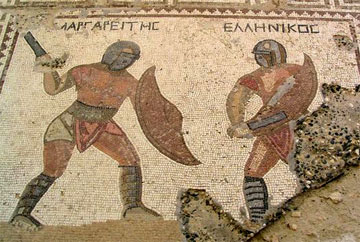
In this mosaic scene, one can discern the tall greaves and leggings and rectangular shield of the Thraex, as well as the feathers that decorate his helmet. The murmillo, the crest of his helmet equally elaborate, thrusts his sword over the smaller curved shield of his opponent. The other scene depicts a hoplomachus, who can be identified by his lance, small round shield, and dagger. He stands aside, awaiting the verdict, as the murmillo, who has laid down his shield and is bleeding, raises his finger (ad digitum) in admission of defeat to the referee.
There were, however, two categories of gladiators that fought only opponents of the same type: Equesthe eques (also, equites), ("horseman") [pictured] and the provocatores ("challengers"). Their apparel makes them easy to identify: brimless helmet with visor and two feathers, and a sleeveless tunic, which was belted at the waist and ended at mid-thigh (in comparison with the naked torso of most gladiators). As with other gladiators, the lower legs are wrapped and there is a manica on the right arm. A small round shield was carried, as well as a short sword and lance. Isidore of Seville (Origines, XVIII.53) says that the equites were the first pair to introduce the gladiatorial combats and fought from white horses, although they are invariably shown having dismounted and fighting on foot, thus gaining the name horsemen. For this reason, they only competed against their own kind.
The provocatores are distinguishable by a helmet without crest, a curved rectangular shield, and a sword with a straight blade. In addition, the provocator was the only gladiator to have effective protection for the upper body: a rectangular breastplate . The provocator thus lacked what was a badge of honor for other heavily-armed gladiators: a naked torso. Junkelmann explains: It was in the very nature of the gladiatorial system that fighters were ready to die, and demonstrated that readiness by baring their torsos. If the fighters had been entirely unprotected, the outcome would have been either a brief, unskilled bloodbath or an excessively cautious, boring fighting style. The juxtaposition of armed and unarmed parts of the body controlled the use of weapons and created the conditions for dynamic and skilful swordsmanship. Nor must we forget the visual stimulation of seeing muscular bodies in vigorous exertion, defying death and injury.
There were even more exotic types which we have no visual evidence. Perhaps the most popular was the essedarius (war-chariot fighter). As a sidenote, the female counterpart, the essadaria, is discussed further in this page; collectively, male and female fighters in this category, belong to the essedarii. The chariot, or (essedum) is a name derived from carrus, which, in turn, comes from the Celtic word for a wagon or cart. The essedarius fought on foot and probably used the chariot to make a spectacular entrance to the arena. Once, after a victory, when an essedarius was applauded for setting free the slave who was his driver, Caligula was so annoyed at the gesture that, leaving the amphitheater in a huff, he tripped on the fringe of his toga and fell headlong down the steps, fuming that "The people that rule the world give more honour to a gladiator for a trifling act than to their deified emperors or to the one still present with them" (Suetonius, Life, XXXV.3). Claudius, on the other hand, was more gracious. When the four sons of an essedarius pleaded for their father's discharge, he granted him the rudius (the wooden sword signifying this release), circulating a note among the applauding crowd that they should desire children, themselves, "since they saw that they brought favour and protection even to a gladiator" (Suetonius, Life, XXI.5).
Other exotics are:
* Velites
whose spear was attached to a thong by which it could be retrieved;
* Laquearii
who used a lasso;
* Sagittarii
who fought with bow and arrow;
* Dimachaeri
who used two swords;
* Scissores
the ominously named, meaning "carvers";
* Andabatae
whose helmets effectively acted as blindfolds as they groped to find their opponent (per Encyclopaedia Britannica only, it is stated it was believed that this group too fought on horseback).
There were other forms of gladiators about which little is known.
"The Gladiator, (Latin "swordsman," from gladius, "sword"), a professional combatant in ancient Rome. The gladiators originally performed at Etruscan funerals, no doubt with intent to give the dead man armed attendants in the next world; hence the fights were usually to the death. At shows in Rome these exhibitions became wildly popular and increased in size from three pairs at the first known exhibition in 264 BC (at the funeral of a Brutus) to 300 pairs in the time of Julius Caesar (d. 44 BC). Hence the shows extended from one day to as many as a hundred, under the emperor Titus; while the emperor Trajan in his triumph (AD 107) had 5,000 pairs of gladiators. Shows were also given in other towns of the Roman Empire, as can be seen from the traces of amphitheatres.
There were various classes of gladiators, distinguished by their arms or modes of fighting. The Samnites fought with the national weapons—a large oblong shield, a visor, a plumed helmet, and a short sword. The Thraces ("Thracians") had a small round buckler and a dagger curved like a scythe; they were generally pitted against the mirmillones, who were armed in Gallic fashion with helmet, sword, and shield and were so called from the name of the fish that served as the crest of their helmet. In like manner the retiarius ("net man") was matched with the secutor ("pursuer"); the former wore nothing but a short tunic or apron and sought to entangle his pursuer, who was fully armed, with the cast net he carried in his right hand; if successful, he dispatched him with the trident he carried in his left. There were also the andabatae, who are believed to have fought on horseback and to have worn helmets with closed visors — that is, to have fought blindfolded; the dimachaeri ("two-knife men") of the later empire, who carried a short sword in each hand; the essedarii ("chariot men"), who fought from chariots like the ancient Britons; the hoplomachi ("fighters in armour"), who wore a complete suit of armour; and the laquearii ("lasso men"), who tried to lasso their antagonists.
The shows were announced several days before they took place by bills affixed to the walls of houses and public buildings; copies were also sold in the streets. These bills gave the names of the chief pairs of competitors, the date of the show, the name of the giver, and the different kinds of combats. The spectacle began with a procession of the gladiators through the arena, and the proceedings opened with a sham fight (praelusio, prolusio) with wooden swords and javelins. The signal for real fighting was given by the sound of the trumpet, and those who showed fear were driven into the arena with whips and red-hot irons. When a gladiator was wounded, the spectators shouted "Habet" ("He is wounded"); if he was at the mercy of his adversary, he lifted up his forefinger to implore the clemency of the people, to whom (in the later times of the Republic) the giver left the decision as to his life or death. If the spectators were in favour of mercy they waved their handkerchiefs; if they desired the death of the conquered gladiator they turned their thumbs downward. (This is the popular view; another view is that those who wanted the death of the defeated gladiator turned their thumbs toward their breasts as a signal to stab him, and those who wished him to be spared turned their thumbs downward as a signal to drop the sword.) The reward of victory consisted of branches of palm, and sometimes of money.
If a gladiator survived a number of combats he might be discharged from further service; he could, however, reengage after discharge. On occasion gladiators became politically important, because many of the more turbulent public men had bodyguards composed of them. This of course led to occasional clashes with bloodshed on both sides. Gladiators acting on their own initiative, as in the rising led by Spartacus (q.v.) in 73/71 BC, were considered still more of a menace.
Gladiators were drawn from various sources but were chiefly slaves and criminals. Discipline was strict, but a successful gladiator not only was famous but, according to the satires of Juvenal, enjoyed the favours of society women. A curious addition to the ranks of gladiators was not uncommon under the Empire: a ruined man, perhaps of high social position, might engage himself as a gladiator, thus getting at least a means of livelihood, however precarious. One of the peculiarities of the emperor Domitian was to have unusual gladiators (dwarfs and women), and the half-mad Commodus appeared in person in the arena, of course winning his bouts.
To be the head of a school (ludus) of gladiators was a well-known but disgraceful occupation. To own gladiators and hire them out was, however, a regular and legitimate branch of commerce.
With the coming of Christianity, gladiatorial shows began to fall into disfavour. The emperor Constantine I actually abolished gladiatorial games in AD 325, but apparently without much effect since they were again abolished by the emperor Honorius (393/423) and may perhaps even have continued for a century after that." — Encyclopaedia Britannica ©2003-2006
Note: "Thracian," along with "Gaul" and "Samnite," originally referred to prisoners of war from Thrace, Gaul, and Samnium (in southern Italy), who in the republican period were forced to fight as gladiators and naturally used the weapons and equipment characteristic of their people. In time these terms ceased to indicate the actual ethnicity of the fighter, but simply designated a particular type of gladiator using particular armor and fighting equipment. "Thracian" remained as category until late antiquity, while "Gaul" and "Samnite" disappeared, but the latter may have been the model for the later secutor and murmillo.
The Gladiator Combats
Gladiators were paid each time they fought. Once a gladiator survived three to five years of combat they were considered to have earned their way to freedom. It was rare to find such a freed gladiator; most did not survive. Gladiators fought in arenas, the most famous of course being the Colosseum, which was built by the Flavians. The aura of death was strong in the amphitheater. Images of Hermes, the conductor of souls to the underworld, were in evidence. Apparently new gladiatorial volunteers were beaten with rods by staff dressed as demons (Sen. Apocol. 9.3), perhaps to give them a proper introduction to this place of death. K.M. Coleman calls the arena "the threshold of the underworld."
As a matter of interest, there is absolutely no evidence that the gladiators addressed the emperor with the famous "Hail emperor, they who are about to die, salute you." This sentence was addressed only on one occasion to Claudius by condemned criminals who were about to participate in a naumachia , a staged naval battle (Suetonius, Claudius 21.6). Since it was the purpose of this naumachia to serve as a means of executing criminals by having them kill each other, it is not surprising that they are pessimistic about their survival as their address to the emperor indicates.
When one gladiator was wounded, the typical cries from the spectators were "habet, hoc habet" (he's had it), or "habet, peractum est" (he's had it, it's all over). Gladiators in DuelSome contests were designated ahead of time as sine missione ("without release," or, simply, to the death). In these fights, the referee would allow the gladiator with the advantage to proceed until he killed his opponent (unlike modern day boxing, there were no rounds nor time limit in any form of gladiatorial contest). This type of contest, however, was rare, at least in the early empire, because of humanitarian concerns and the expense to the editor, who had to reimburse the lanista. Augustus even outlawed contests sine missione, although this injunction probably did not remain in effect in later centuries.
In the more typical contest, when one opponent had decided that he was defeated, the defeated gladiator, would throw his shield to the ground and gives a signal of submission to the referee with the forefinger of his left hand. The victorious fighter would remain standing proudly, still holding his shield. As literary sources make clear, the spectators expressed their judgment with some gesture involving the thumb (pollice verso, or "turned thumb"). Unfortunately, there is no visual evidence that can confirm or contradict exactly how the gestures were made and what they meant.
Those who urged mercy for the defeated gladiator called out "mitte" ("release him") and waved the hem of their garment. The final decision lay with the editor, the giver of the games, who most often under the empire was the emperor himself. If the decision was death, there was a ritual to be performed, which would bring honor in death for the loser. With one knee on the ground, the loser would ceremoniously grasp the thigh of the victor, who, while holding the helmet or head of his opponent, plunged his sword into his neck. Victorious GladiatorThis was the moment of truth, which fascinated the Roman audience, much like the defeat of a bull in a bullfight. The dead body was removed by costumed attendants; one dressed impersonating Pluto, the god of the dead, struck the corpses with a mallet, perhaps signifying the god's ownership of the body. Another attendant dressed as Mercury, escorter of souls to the underworld, used his wand, which was in reality a hot iron, to see whether the gladiator was really dead or not. There was no escape by feigning death..
The victor received from the editor a palm branch and a sum of money. A laurel crown was awarded for an especially outstanding performance. The victor then ran around the perimeter of the amphitheater, waving the palm. The ultimate prize awarded to gladiators was permanent discharge from the obligation to fight in the arena, most certainly in recognition of a brilliant career rather than of just one performance. As a symbol of this award, the editor gave the gladiator a wooden sword (rudis), perhaps to suggest that he no longer had to fight with real weapons at the risk of his life.
Martial (Spect. 27) mentions an extraordinary match between gladiators named Priscus and Verus, who fought so evenly and bravely that when they indicated submission (with the forefinger as above) at the same time, the emperor Titus, encouraged by shouts of missio ("release") for both men from the crowd, awarded victory to both and gave them wooden swords (rudes). If the defeated gladiator was allowed to live, he, along with the victor, was given all necessary medical treatment, which was of the highest quality available.
Gladiatorial shows also held a political significance. In the Republic, gladiatorial contests brought great popularity to the giver of the games, which paid off in votes at election time. In fact, political competition among aristocrats was an important factor in the spectacular growth of gladiatorial contests. There was great pressure to make your munus more impressive than the last. As stated earlier, Julius Caesar in 65 BC, the year of his aedileship, planned to give a gladiatorial exhibition consisting of 320 pairs of fighters. Although this exhibition was a munus in memory of his father, Caesar no doubt was also seeking to win political favor for his candidacy for the praetorship. The munus was given, but with a somewhat reduced number of gladiators and perhaps, less political favor for Caesar. Caesar's political enemies had passed legislation restricting the number of gladiators that could be kept in Rome, a measure that could be justified by appealing to public safety. Gladiators could be a threat to the state as the famous revolt of Spartacus (73-71 BC) proved. However, it was most likely also motivated by jealousy and political self-interest. (Suetonius, Julius Caesar 10).
The following is a passage from Petronius' Satyricon (45). Although it is fictional, provides a very good example of the connection between giving gladiatorial shows and political favor. The speaker is the freedman Echion, a blanket-maker, who is a citizen of an unnamed town in southern Italy and talks about three politicians (Titus, Mammea, and Norbanus) trying to win the favor of the townspeople.
Just consider this: we will enjoy an excellent gladiatorial show in three days on a festival day; the gladiatorial troop is not owned by a lanista, but consists of very many freedmen and our Titus is generous and headstrong: no matter what kind of show it will be, it certainly will be something! For I am a friend of his; he will pull out all stops. He will give a wonderful gladiatorial show, to the death, a regular slaughter house in the middle of the arena, for the spectators to see. And he has the financial means: when his father died, left him thirty million sesterces. Even if he spends 400,000 sesterces on the show, his patrimony won't even feel it, and he will be remembered forever. The show will include dwarves and a female chariot fighter and the slave steward of Glyco, who was caught screwing his mistress. In the crowd you will observe a brawl between the jealous types [who would side with the husband Glyco] and the lovers [who would side with the steward]. Glyco, moreover, a penny-pinching man, has handed over his steward to be killed by the beasts. Glyco is just making himself look ridiculous. What wrong has a slave committed, who was forced. That chamber-pot of a wife deserves to be tossed around by a bull. But Glyco is taking out his anger at his wife on his steward. I suspect that Mammea will give a gift of two denarii to me and people like me. If he does, he will steal Norbanus' popular support. You can bet that Mammea will easily win the election. And truth be told, what good did Norbanus ever do for us? He presented worthless gladiators, already infirm, who would have collapsed if you had blown on them. I have seen better beast fighters. Norbanus caused the death of mounted gladiators, who were the size of those that serve as a lamp decoration; they were so small that you would have thought that they were roosters! One was a skinny runt, another was club-footed, the third might as well have been dead: he had torn tendons. There was a Thracian gladiator of some quality, but he fought mechanically, by the numbers. Eventually all these were all flogged ; the crowd had shouted: "whip them," but these were not real contests. "Nevertheless," Norbanus said, "I have given you a gladiator show." And I applaud you, but if you think about it, I gave more to you than I received.
"Dwarves" as mentioned in the quote, is a conjecture because there is no satisfactory translation of the actual reading of manuscript. The conjecture does make sense because the Romans loved exotic variations on gladiatorial combat. Note the female chariot fighter and later, the mounted gladiators.
Under the Empire, when magistrates at Rome were no longer chosen by popular elections, the political incentive disappeared and even more important, the emperor did not want prominent citizens giving entertainments that might win too much popular favor to the detriment of his own support. Thus the emperor became the regular sponsor of gladiatorial games in Rome and normally attended the gladiatorial contests he sponsored. In this way, these games took on new political meaning. Although the common people had lost the ability to vote, the amphitheater provided them with an opportunity to communicate their feelings and desires directly to their ruler. Moreover, since there was safety in numbers, it was not necessary for the them to repress their true feelings in the emperor's presence. They could loudly complain of the price of wheat, or call for the death of an unpopular official, or even criticize the emperor himself. As Alison Futrell writes:
The main point is that [the people] were making themselves heard, directly, face to face with the emperor. They had an unique opportunity for immediate vocal contact with their heads of state, and they used it. The image of direct communication was more important than the communication itself.
Public demonstrations in the amphitheater on one occasion indirectly led to the assassination of an emperor. Caligula's refusal to listen to the crowd and his attempt to have soldiers execute vociferous members of the crowd inflamed the crowd and emboldened conspirators to kill him (Josephus, De Bello Judiaco 19.24-7). On the other hand, a wise emperor could profit politically from his appearance in amphitheater by showing that he had the same interests as his people. This rubbing of elbows with the common herd was deemed necessary for the emperor's public relations because it partially dissolved social and political barriers. For this moment or day or week, the government was not an impersonal and impervious body, distanced from the average person, but a fellow-spectator, practically within reach, one with the Populus Romanus.
The adoring crowd received a popular emperor with thunderous applause in appreciation for this public appearance and for his sponsorship of the games. Tiberius, at least early in his reign, attended the games regularly in order to preserve the stability of his rule. Claudius attended the games with whole-hearted enthusiasm and played to the crowd. When he presented gold coins to victorious gladiators, he playfully counted them out in time with the crowd (Suetonius, Claudius 21). Perhaps the orator Fronto has best expressed the political importance of spectacles in a letter discussing the rule of the emperor Trajan (Letters 2.18.9-17): The following are derived from the most important principles of political science: that he [Trajan] as emperor has given his attention even to actors and the other artists of the theater, or circus [chariot-racing], or arena [gladiatorial combat] because he knew that the Roman people are concerned especially with two things, the grain supply and spectacles; [he also realizes] that his rule has won approval as much because of games as because of serious things and also that serious things are neglected with greater loss, but games, with greater resentment; that the human drives that lead men to demand the grain dole are less powerful than those which lead them to desire spectacles; that only the people eligible for the grain dole are won over by handouts of grain, and at that individually, whereas the whole people are won over by spectacles.
The Ampitheaters
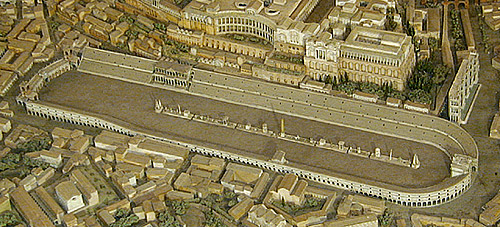
Up until the late first century BC gladiatorial combats were held in the Forum, the Circus Maximus, and at other similar sites. When the games were held in the Forum, temporary wooden stands were put up. In 53 BC, the politician Curio (or at least, one of his architects) had an interesting idea. Curio had two semi-circular wooden stands built on a pivot. When these stands were back-to-back, the spectators in each were treated in the morning to a different theatrical presentation, but in the afternoon the two sets of stands were swiveled about so that they together formed an oval. AmpitheaterThus the amphitheater was born. The first permanent stone amphitheater in Rome was built by Statilius Taurus in 29 BC.
The greatest Roman amphitheater, the Colosseum, has remained a tourist attraction from the first century AD to the present day . The exterior of the Colosseum consists three tiers of arches and an attic story (most of the third tier and attic story have not survived). The underground area, (hypogeum), was used for storage of equipment and to house wild animals. Elevators raised animals in cages from this underground level so that they could enter the arena through trap doors. Since the hard-packed ground of the old amphitheaters could not soak up the quantities of blood spilled on it in a contest, the show producers covered the ground with absorbent arena (sand) so the contestants would not slip and fall during their battles. It was this harena, or arena, the Latin word for "sand" that became the general term for shows, and arena sports in the modern world.
The name"Colosseum" came from a colossal statue (120 ft. high) of Nero that was located in the area near this amphitheater, however, it was not called the "Colosseum" until the Middle Ages. Since it was built by the members of the Flavian dynasty (Vespasian, Titus, and Domitian), its name in ancient times was the "Flavian Amphitheater." It was dedicated in 80 AD by the emperor Titus and estimates of its capacity range from 40,000 to about 60,000. Amphitheaters could be found throughout the rest of Italy, as well as all over the Roman world in Spain, Gaul, northern Africa, and the Greek east. Many amphitheaters in southern France are very well preserved and still in use as venues for bullfights, such as the one in Arles.

The amphitheater was a microcosm of Roman society. The seating arrangements reflected the stratification of Roman society. Coin-like tickets called tesserae, probably distributed through the patron-client network, were required for admission. Ampitheater of Alexandria On a large podium the emperor had a special box and senators sat on marble seating divided into fourteen sections. Next came the members of the equestrian order, who sat in the lowest tier (ima cavea) of the amphitheater, consisting of twelve rows of marble seating divided into sixteen sections. Roman citizens affluent enough to afford to wear a toga occupied nineteen rows of marble seats in sixteen sections in middle of the seating area (media cavea). Above them in the summa cavea sat poorer citizens clad in dark garments (the pullati), slaves, freedmen, and foreigners residing in Rome. Women from these groups probably also sat among the men. This tier consisted of seven rows of limestone seating divided into sixteen sections. Finally, at the very top of the amphitheater was an gallery with wooden seats (summum maenianum in ligneis) on which sat wives of senators and equestrians protected from sun and rain by a colonnade. The rest of the spectators were screened from the sun by awnings suspended from poles that were installed around the rim of the Flavian amphitheater on the attic story. An indication that these awnings were not always used everywhere is the fact that they were mentioned very specifically in advertising (CIL 4.1190 and 4.3884). The Latin word for these awnings was vela, which also means 'sails'. In fact, a company of sailors were in charge of the awnings of the Flavian Amphitheater. "Although in the past custom permitted [upper-class] women to view gladiatorial combat while sitting scattered throughout the amphitheater, Augustus allowed them to do so only from the higher part of the auditorium" (Suet. Aug. 44).
The podium, ima cavea and media cavea thus consisted of reserved seating, in which subdivisions of each group sat together, while the summa cavea most likely consisted of unreserved seating. The status of a senator determined in what section he sat on the podium, as did that of an equestrian in the ima cavea. For example, in ima cavea there was a section reserved for those equestrians who had been assigned the honor of "with public horse," and who served on special jury panels. There even seems to have been a section reserved for bankrupt equestrians. In the media cavea soldiers were separated from civilians, married men from bachelors; boys and their tutors sat together, and so forth. In these three tiers the status of an individual in Roman society and within his own class would have been clear at a glance.
In the minds of the Romans, the amphitheater was a place of significant symbolic meaning. It was a place of civilized order where, from the Roman point of view, the victory of civilization over lawlessness, chaos, barbarism, and savagery was regularly enacted. It was also a place of justice; capital punishment was prevalent. Certain criminals were executed there by being given to the wild beasts or were forced to fight to the death as gladiators. It also represented the domination of Rome over its enemies: prisoners of war were either executed or forced to fight each other as gladiators. For the professional gladiator, however, the amphitheater was also a place of redemption, in which one could overcome death by victory or by stoically accepting it.
Subsequent to the great fire (64 BC) Nero had seized for his own estate a huge parcel of choice land in the middle of Rome on which he built his grandiose palatial complex called "the Golden House." After Nero's death, Vespasian restored this land to the people of Rome and built his amphitheater, which could be enjoyed by Romans of all classes, on the site of Nero's artificial lake. Vespasian also removed the head of the colossal statue of Nero and replaced it with that of the sun god. Martial expresses his gratitude to Vespasian's son, Titus, for this dramatic change in Rome's landscape by comparing the glorious present with the awful past (Spect. 2):
Here where the gleaming colossus sees the stars from a closer distance
And high scaffolding increases in the middle of the road,
The hateful halls of the savage king used to radiate light and
One home [i.e., the Golden House] then was occupying the whole city.
Here where the venerable mass of the remarkable amphitheater
Is being erected, was the artificial lake.
Here where we wonder at the quickly built gift of bath buildings,
The haughty estate had taken away homes from the poor.
Where the Claudian portico unfolds extensive shadows,
Was the very edge of the palace.
Rome has been restored to itself and under your leadership, Caesar,
his area is now the delight of the people, which had been the private pleasure of the tyrant.
The Venatio
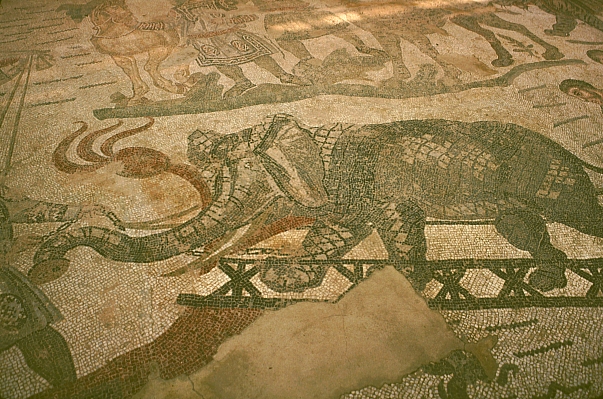
Humans were not the only combatants in the gladiator games. Another popular spectacle that was associated with gladiatorial contests was the venatio (hunt), which involved the "hunting" and slaying of wild animals. The word venatio, however, was actually an umbrella term that included other associated spectacles, such as displays of exotic species from conquered provinces, exhibitions of trained animals, fights between animals of different species, and execution of criminals. Exotic wild beasts from the far reaches of the Roman empire were brought to Rome and hunts were held in the morning prior to the afternoon main event of gladiatorial duels. The venatio, originally held in the Circus Maximus, in the early empire was incorporated into the munus in the amphitheater. Depiction of the Venatio The venatio became a kind of warm-up act in the morning, with the main event, gladiatorial combat, taking place in the afternoon.
Measures were taken to protect spectators in the amphitheater from dangerous wild animals. In the Colosseum, these beasts were kept in cages underneath the arena, which were raised by ropes and pulleys to gaited openings in the podium. The animals were then released into the arena. Rollers at the top of the arena wall covered with polished marble prevented animals from climbing up into the crowd. Nets were also employed to keep animals away from the walls as an extra protection and also to make sure that they were visible from all parts of the auditorium. Along the arena wall were a number of small balconies holding archers as a last defense.
Although most of the animals hunted were ferocious, there were some species that were not. Animals that appeared regularly in the venatio included lions, elephants, bear, deer, wild goats, dogs and camels. Some of these animals were trained and rather than fighting, performed entertaining tricks.
The trained hunter was called a venator, who was a level below the gladiator on the ladder of public esteem. Down at the bottom was the bestiarius ("beast-fighter"), as one can well imagine. Although bestiarii were recruited from the same source as gladiators (prisoners of war, criminals, etc.), they were despised, probably because they had little or no training. The men that did battle with the animals, the bestiarii, or hunters of wild beast, were usually criminals and fought the animals without benefit of weapons or armor.
A story is told of one unwilling bestiarius avoided participation in a venatio by sticking his head through the spokes of a wheel of the cart in which he was being carried to the show and allowing his neck to be broken when the cart began to move. Seneca tells a story of a German prisoner of war who went to extreme lengths to avoid participating in one of these hunts (Ep. 70.20):
"Recently in a bestiarii show [i.e., a venatio], one of the Germans, when he was being prepared for a morning spectacle, withdrew to relieve himself — no other privacy was allowed to him without a guard; in the lavatory area he stuffed into his throat the stick with a sponge attached which was used to wipe away excrement and with his breathing passage obstructed he choked to death …"
Marcus Junkelmann (The Power of Spectacle in Ancient Rome: Gladiators and Caesars, K�hne and Ewigleben) says that the word bestiarii is also applied to assistants who took care of animals and goaded them into fighting. Kyle (Spectacles of Death in Ancient Rome) points out that the word bestiarius is sometimes used of condemned victims (noxii meaning "guilty")who were thrown to the beasts for punishment. Bestiarius eventually became a synonym for venator, a trained fighter of animals.
A venatio consisted of hunters stalking and killing ferocious and some not so ferocious wild animals in the narrow confines of the arena. In 79 BC Pompey gave games in which expert hunters (desert nomads called the Gaetuli) were imported to kill about twenty African elephants. Venatio Bas ReliefA few years later Caesar pitted 500 infantrymen against approximately the same number of elephants. Cicero wrote about a later show given by Pompey in 55 BC, in which another elephant hunt took place (ad Fam. 7.1.1-3):
"The rest of the hunts took place twice a day for five days; they were magnificent, nobody denies it. But what pleasure can there be for a civilized man when either some powerless man is ripped to shreds by a powerful beast or some magnificent animal is transfixed by a spear? But if this kind of show must be viewed, you have seen the same thing often in the past. We who were present at these spectacles saw nothing new. The last day belonged to the elephants. The common crowd found much to admire in this event, but did not really enjoy it. To the contrary, a certain pity was aroused in them and they came to the opinion that this beast shared a certain affinity with the human race."
Very few animals survived these hunts though they did sometimes defeat the bestiarius. Literally thousands of wild animals would be slaughtered in one day. At the games Trajan held when he became emperor, over 9,000 animals were killed. The venatio could also involve animals being pitted against each other. Despite the cruelty and bloody nature of the venatio, there was one aspect of this spectacle that had a lighter side. Occasionally their would be a performance of trained animals as in modern circus. Seneca mentions other such performances (Ep. 85.41): "… a trainer inserts his hand into the jaws of a lion, a keeper kisses his tiger, a very small Ethiopian orders an elephant to kneel down and to walk a tightrope.
As horrific as these savage slaughters of animals sound, it is something that predominated mankind as we grew more "civilized." Even today, bullfights are prime examples of a venatio. Once hunting ceased to be a means of survival and became a sport, the killing of wild animals was viewed as a demonstration of man's mastery of nature. Consider this: wild animals brought to Rome from various parts of the empire, were killed both as a symbol of Roman domination over its empire and also as a demonstration of man's civilized domination over wild nature. Even the domesticated bull, a frequent participant in the venatio, was a familiar symbol of savagery in the Mediterranean world. In the ancient world this attitude is best illustrated by the myth of Hercules' labors, which involved the killing or subduing of savage beasts like the Nemean lion, the Lernaean Hydra (a large water snake), the Ceryneian deer, the Stymphalian birds, and the Cretan bull. A more modern example, "Buffalo Bill" Cody and Wild Bill Hickok killed hundreds of buffalo for no other purpose than to display their hunting skill. Other hunters followed their example, almost making the buffalo extinct. African big game hunters thrive on that vicarious sense of power over nature: the fox hunt, that of the elite, in which hunters on horseback, dressed in dashing red coats and white britches, along with a pack of dogs pursues a fox until the dogs catch it and tear it apart.
Too, the Romans were accustomed to the killing of animals in sacrificial ritual. Because of the numerous religious festivals in a polytheistic society, sacrifice was a common sight in front of temples in the city. Finally, the venatio had a democratic aspect. Since in Roman culture (as in all ancient cultures) hunting was an aristocratic activity, the venatio gave the Roman common man an opportunity to participate in this pastime, at least as a spectator.
Following the venatio in the order of daily events were the humiliores, the execution of Roman citizens of lower status. Usual forms of execution included burning at the stake, crucifixion, or ad bestias (when the prisoner is left alone in the ring with one or more wild animals). Ancient writers suggest that during the humiliores, most respectable men and women went for lunch instead of staying to watch.
Capital Punishment

Capital punishment, called naumachia, was often carried out in the amphitheater as part of the morning venatio by requiring criminals who had committed capital crimes , known as the damnati ad mortem, to face wild animals without the benefit of weapons and armor and at noon (Sen. Ep. 7.2.5) when condemned criminals, unprotected by any kind of armor, fought each other with swords to the death. NaumachiaThe former punishment was called ad bestias (to the beasts) and was ranked alongside crucifixion as the most disgraceful of all penalties. Because of its shamefulness, it was deemed appropriate for slaves and lower class citizens (convicted upper class citizens were usually beheaded). Christians were singled out for condemnation ad bestias because their refusal to acknowledge the gods of the state put them completely outside the pale of society. Another way of presenting the condemned to wild animals for punishment was to tie them to a stake or to wheel them out in a little cart.
In the noon time event, condemned criminals fought each other as if they were gladiators. Each combat was literally a "sudden death" contest, the winner of which had to fight other criminals until he himself was killed. In this way the condemned executed each other. What happened to the ultimate winner is not known; perhaps he was pardoned or at least allowed to live to fight another day. Seneca took a strictly utilitarian and judicial view of these contests. (Ira 1.6.4): The purpose of executing criminals in public] is that they serve as a warning to all, and because in life they did not wish to be useful citizens, certainly the state benefits by their death.

Seneca, however, was in the minority. Naumachia These executions were viewed by the Roman people as amusement. On occasion, in order to enhance the entertainment value of this event, the condemned would be required to play a starring role in an dramatic enactment of a famous myth that would end in mutilation or death. Tertullian mentions dramatic representations of the castration of Attis and the death of Hercules on a funeral pyre (Apologia to the Roman Rulers, 15). Sometimes these enactments would have a surprise ending as when in the Flavian Amphitheater a condemned criminal impersonated Orpheus whose music was famous for its miraculous effect on nature. Martial in a poem addressed to emperor Titus describes what happened (Spect. 21):
Whatever the Thracian mountain Rhodope is said to have witnessed
during Orpheus' performance, the arena exhibited to you, Caesar.
Rocks crawled and the forest amazingly moved quickly,
Just as it is believed the grove of the Hesperides did.
Rapt, every type of wild animal intermingled with the tame herd was listening
As was many a bird suspended in air above the poet.
But ultimately our Orpheus lay on the ground mangled by a displeased bear
Likewise some reluctant gladiators had to be whipped and even wild animals often had to be provoked to attack other animals and human beings, as Martial indicates in this poem (Spect. 22):
While the trainers were gingerly provoking a rhinoceros,
And the anger of the great wild beast was taking a long time to build up,
The anticipated battle looked as if it would not take place.
But finally the rage of the beast previously much in evidence returned,
For he thus lifted up a heavy bear with his twin horns
The Essadaria: Female Gladiators
"There was another exhibition that was at once most disgraceful and most shocking, when men and women not only of the equestrian but even of the senatorial order appeared as performers in the orchestra, in the Circus, and in the hunting-theatre [Colosseum], like those who are held in lowest esteem. Some of them played the flute and danced in pantomimes or acted in tragedies and comedies or sang to the lyre; they drove horses, killed wild beasts and fought as gladiators, some willingly and some sore against their will." — Cassio Dio, Roman History (LXII.17.3)
I have to laugh sometimes, when I hear a comment made that a woman should not play professional sports considered "dangerous" like football. Yes, women once competed in the gladiatorial arena, and even in those times, there was much controversy. Aristocratic women and men fought as an entertainment for Nero in 63 AD. Domitian had women fight by torchlight and on another occasion had women fight with dwarves. Romans loved these exotic gladiatorial combats. In Petronius, one character looks forward to the appearance of a female gladiator, called an essedaria (Sat. 45.7.2), known for competing against men (the only female gladiator to do so); the females however it seems fought from chariots in the manner of the Britons. This is the feminine of the term essadarius, the (male) chariot gladiator.
It is well-known that the Roman emperor Septimius Severus, who ruled from 193 to 211 CE, allowed women to fight as gladiators, but finally banned the tradition in 200 CE, suggesting suggests that women were taking up this occupation in alarming numbers.
Increasingly elaborate displays were hosted by Titus in the dedication of the Colosseum and baths. "There was a battle between cranes and also between four elephants; animals both tame and wild were slain to the number of nine thousand; and women (not those of any prominence, however) took part in despatching them" (Dio, LXVI.25.1). Martial, whose Spectacles were written to celebrate the inauguration of the amphitheater in AD 80, also speaks of women fighting in the arena, "It is not enough that warrior Mars serves you in unconquered arms, Caesar. Venus herself serves you too" (VII). Domitian, the younger brother of Titus, who succeeded him the following year, is explicitly said to have presented women as gladiators. He "gave hunts of wild beasts, gladiatorial shows at night by the light of torches, and not only combats between men but between women as well" (Suetonius, IV.1) and "sometimes he would pit dwarfs and women against each other" (Dio, LXVII.8.4).
Juvenal (60-140AD), a contemporary of Martial (XII.18), is especially critical of women from distinguished and illustrious families disgracing themselves in the arena or, for that matter, being enamored of gladiators and prizing them above home and country (VI. 82ff). In his scathing attack upon women learning to fight in the Ludus gives us one of the greatest insights into the female gladiator:
"Who has not seen the dummies of wood they slash at and batter
Whether with swords or with spears, going through all the moves?
These are the girls who blast on trumpets in honour of Flora.
Or, it may be, they have deeper designs, and are really preparing for the arena itself. How can a woman be decent
Sticking her head in a helmet, denying her sex she was born with?
Manly feats they adore, but they wouldn't want to be men,
Poor weak things (they think), how little they really enjoy it!
What great honour it is for a husband to see, at an auction
Where his wife's effects are up for sale, belts, greaves,
Manica and plumes!
Hear her grunt and groan as she works at it, parrying, thrusting;
See her neck bent down under the weight of her helmet.
Look at the rolls of bandage and tape, so her legs look like tree trunks,
Then have a laugh for yourself after the practice is over,
Armour and weapons are put down, and she squats as she uses the vessel.
Ah, degenerate girls of the line of our praetors and consuls,
Tell us, whom have you seen got up in any such fashion,
Panting and sweating like this? No gladiators wench,
No tough stip-tease broad would ever so much as attempt it."
Recently, the remains of a young woman, approximately twenty (20) years old, were found in Britain. She was discovered in a Roman cemetery in the area of London known as Southwark and excavated in 1996 by archaeologists who uncovered the remains of the young woman buried with several items that may very well identify her as a female gladiator.

A foremost piece of archaeology left of female gladiators today comes from Halicarnassus, currently held in the British Museum. The stone shows two female fighters with their names "Amazonia and Achillea" included with the two helmet less fighters. Missio at HalicarnassusAchilles is said to have killed and then fallen in love with Penthesilea (Penthesileia), queen of the Amazons (Smyrnaeus, I.843ff), her beauty conquering the conqueror (Propertius, Elegies III.11). The names, therefore, seem especially appropriate and one wonders if they were chosen deliberately. They stand opposite one another armed with swords and crouched behind scuta. Although heavily armed in the manner of the secutor, with greaves and the right arm protected and carrying a large oblong shield, the heads of the women are bare (as are their breasts). The absence of helmets is a curious omission and may be due simply to the desire to see the faces of the combatants, given the rarity of such encounters and how evenly matched were the protagonists. At their feet are either their helmets or the head and shoulders of the watching crowd. Coleman, however, suggests that the two round objects on either side of the names represent, not spectators, but helmets, signifying that each gladiatrix has qualified for missio. The inscription in Greek declares them missae sunt, that they both have received missio and been granted a reprieve from this particular contest. Of all the scant information left us about female gladiators this is one of the most compelling as it shows they fought against other females fighters and were taken seriously enough to have a large stone carved in their honour. It is in this stone that we can also find something of the Roman fascination for Greek legend. In the names of the two women we can find a parady of the Greek myth of Amazon being killed by Achilles. The stone is currently dated between the First and Second Centuries AD, presumably because we know Emperor Severus declared female gladiators illegal in 200 CE.
According to the curator of early London history at the London Museum, the items buried with the woman were a dish decorated with a fallen gladiator and other ceramic pieces decorated with similar scenes and gladiatorial symbols. Notably three of the eight lamps found in the grave are decorated with the Egyptian god Anubis, who was associated with the Roman messenger god Mercury. This association is important because in Roman times slaves dressed as Mercury removed the dead bodies from the arena. Mercury, and his Greek counterpart Hermes, traditionally led human souls to the underworld.
Despite the existence of archaeological evidence that supports the existence of female gladiators, no one is sure that the remains uncovered in London are actually those of a female gladiator. If the young woman was indeed a gladiator, the wealth of materials found with her indicate that she was quite popular. Her remains are on display at the London Museum.






 Entries


