Showing posts with label Greece. Show all posts

The Greek Alphabet: Hellenic Invention or Phoenician Invasion?

By: George C. Chryssi

The question whether the Greek alphabet is an invention of the Hellenes, or it is a modified import of the Phoenician alphabet, has long been debated by linguists, scholars and historians alike.
The web site “writingsystems.com” states that “although Greek has traditionally been considered to be the mother of alphabets, the first to represent vowels as well as consonants, scholars are now divided on whether Greek was in fact the ancestor of all others or whether some [letters] came from Phoenician in other ways.”
In addition, in the book “The World of the Bible” the author, Roberta Harris, writes that “to the Greeks also belongs the credit for the invention of the vowel system… when the Greeks founded colonies in Italy, the alphabet was taken up by the peoples there… and has come down to us via the Romans…”
This article is based on extensive (but, by no means exhaustive) research that the author has done on the subject, in an attempt to show that ancient, as well as recent evidence, point to a favorable conclusion that the alphabet is indeed a Hellenic invention, albeit its final form, as we know it today, is the result of refinement and iterations of Hellenic writing systems through millennia of usage in the Aegean basin and the Levant.

Venus and Adonis

Venus, playing one day with her boy Cupid, wounded her bosom with one of his arrows. She pushed him away, but the wound was deeper than she thought. Before it healed she beheld Adonis, and was captivated with him. She no longer took any interest in her favorite resorts—Paphos, and Cnidos, and Amathos, rich in metals. She absented herself even from heaven, for Adonis was dearer to her than heaven. Him she followed and bore him company. She who used to love to recline in the shade, with no care but to cultivate her charms, now rambles through the woods and over the hills, dressed like the huntress Diana; and calls her dogs, and chases hares and stags, or other game that it is safe to hunt, but keeps clear of the wolves and bears, reeking with the slaughter of the herd. She charged Adonis, too, to beware of such dangerous animals. “Be brave towards the timid,” said she; “courage against the courageous is not safe. Beware how you expose yourself to danger and put my happiness to risk. Attack not the beasts that Nature has armed with weapons. I do not value your glory so high as to consent to purchase it by such exposure. Your youth, and the beauty that charms Venus, will not touch the hearts of lions and bristly boars. Think of their terrible claws and prodigious strength! I hate the whole race of them. Do you ask me why?” Then she told him the story of Atalanta and Hippomenes, who were changed into lions for their ingratitude to her.

Glaucus and Scylla

Glaucus was a fisherman. One day he had drawn his nets to land, and had taken a great many fishes of various kinds. So he emptied his net, and proceeded to sort the fishes on the grass. The place where he stood was a beautiful island in the river, a solitary spot, uninhabited, and not used for pasturage of cattle, nor ever visited by any but himself. On a sudden, the fishes, which had been laid on the grass, began to revive and move their fins as if they were in the water; and while he looked on astonished, they one and all moved off to the water, plunged in, and swam away. He did not know what to make of this, whether some god had done it or some secret power in the herbage. “What herb has such a power?” he exclaimed; and gathering some of it, he tasted it. Scarce had the juices of the plant reached his palate when he found himself agitated with a longing desire for the water. He could no longer restrain himself, but bidding farewell to earth, he plunged into the stream. The gods of the water received him graciously, and admitted him to the honor of their society. They obtained the consent of Oceanus and Tethys, the sovereigns of the sea, that all that was mortal in him should be washed away. A hundred rivers poured their waters over him. Then he lost all sense of his former nature and all consciousness. When he recovered, he found himself changed in form and mind. His hair was sea-green, and trailed behind him on the water; his shoulders grew broad, and what had been thighs and legs assumed the form of a fish’s tail. The sea-gods complimented him on the change of his appearance, and he fancied himself rather a good-looking personage.

The Search for Cleopatra

Cleopatra VII was born in Egypt, but she was descended from a lineage of Greek kings and queens who had ruled Egypt for nearly 300 years. The Ptolemies of Macedonia are one of history's most flamboyant dynasties, famous not only for wealth and wisdom but also for bloody rivalries and the sort of "family values" that modern-day exponents of the phrase would surely disavow, seeing as they included incest and fratricide.

The Ptolemies came to power after the conquest of Egypt by Alexander the Great, who in a caffeinated burst of activity beginning in 332 B.C. swept through Lower Egypt, displaced the hated Persian occupiers, and was hailed by the Egyptians as a divine liberator. He was recognized as pharaoh in the capital, Memphis. Along a strip of land between the Mediterranean and Lake Mareotis he laid out a blueprint for Alexandria, which would serve as Egypt's capital for nearly a thousand years. After Alexander's death in 323 B.C., Egypt was given to Ptolemy, one of his trusted generals, who, in a brilliant bit of marketing, hijacked the hearse bearing Alexander's body back to Greece and enshrined it in a tomb in Alexandria. Ptolemy was crowned pharaoh in 304 B.C. on the anniversary of Alexander's death. He made offerings to the Egyptian gods, took an Egyptian throne name, and portrayed himself in pharaonic garb.

The dynasty's greatest legacy was Alexandria itself, with its hundred-foot-wide main avenue, its gleaming limestone colonnades, its harborside palaces and temples overseen by a towering lighthouse, one of the seven wonders of the ancient world, on the island of Pharos. Alexandria soon became the largest, most sophisticated city on the planet. It was a teeming cosmopolitan mix of Egyptians, Greeks, Jews, Romans, Nubians, and other peoples. The best and brightest of the Mediterranean world came to study at the Mouseion, the world's first academy, and at the great Alexandria library. It was there, 18 centuries before the Copernican revolution, that Aristarchus posited a heliocentric solar system and Eratosthenes calculated the circumference of the Earth. Alexandria was where the Hebrew Bible was first translated into Greek and where the poet Sotades the Obscene discovered the limits of artistic freedom when he unwisely scribbled some scurrilous verse about Ptolemy II's incestuous marriage to his sister. He was deep-sixed in a lead-lined chest.

Proserpine

When Jupiter and his brothers had defeated the Titans and banished them to Tartarus, a new enemy rose up against the gods. They were the giants Typhon, Briareus, Enceladus, and others. Some of them had a hundred arms, others breathed out fire. They were finally subdued and buried alive under Mount Ætna, where they still sometimes struggle to get loose, and shake the whole island with earthquakes. Their breath comes up through the mountain, and is what men call the eruption of the volcano.

The fall of these monsters shook the earth, so that Pluto was alarmed, and feared that his kingdom would be laid open to the light of day. Under this apprehension, he mounted his chariot, drawn by black horses, and took a circuit of inspection to satisfy himself of the extent of the damage. While he was thus engaged, Venus, who was sitting on Mount Eryx playing with her boy Cupid, espied him, and said, “My son, take your darts with which you conquer all, even Jove himself, and send one into the breast of yonder dark monarch, who rules the realm of Tartarus. Why should he alone escape? Seize the opportunity to extend your empire and mine. Do you not see that even in heaven some despise our power? Minerva the wise, and Diana the huntress, defy us; and there is that daughter of Ceres, who threatens to follow their example. Now do you, if you have any regard for your own interest or mine, join these two in one.” The boy unbound his quiver, and selected his sharpest and truest arrow; then straining the bow against his knee, he attached the string, and, having made ready, shot the arrow with its barbed point right into the heart of Pluto.

Baucis and Philemon

On a certain hill in Phrygia stands a linden tree and an oak, enclosed by a low wall. Not far from the spot is a marsh, formerly good habitable land, but now indented with pools, the resort of fen-birds and cormorants. Once on a time Jupiter, in human shape, visited this country, and with him his son Mercury (he of the caduceus), without his wings. They presented themselves, as weary travellers, at many a door, seeking rest and shelter, but found all closed, for it was late, and the inhospitable inhabitants would not rouse themselves to open for their reception. At last a humble mansion received them, a small thatched cottage, where Baucis, a pious old dame, and her husband Philemon, united when young, had grown old together. Not ashamed of their poverty, they made it endurable by moderate desires and kind dispositions. One need not look there for master or for servant; they two were the whole household, master and servant alike. When the two heavenly guests crossed the humble threshold, and bowed their heads to pass under the low door, the old man placed a seat, on which Baucis, bustling and attentive, spread a cloth, and begged them to sit down. Then she raked out the coals from the ashes, and kindled up a fire, fed it with leaves and dry bark, and with her scanty breath blew it into a flame. She brought out of a corner split sticks and dry branches, broke them up, and placed them under the small kettle. Her husband collected some pot-herbs in the garden, and she shred them from the stalks, and prepared them for the pot. He reached down with a forked stick a flitch of bacon hanging in the chimney, cut a small piece, and put it in the pot to boil with the herbs, setting away the rest for another time. A beechen bowl was filled with warm water, that their guests might wash. While all was doing, they beguiled the time with conversation.

On the bench designed for the guests was laid a cushion stuffed with sea-weed; and a cloth, only produced on great occasions, but ancient and coarse enough, was spread over that. The old lady, with her apron on, with trembling hand set the table. One leg was shorter than the rest, but a piece of slate put under restored the level. When fixed, she rubbed the table down with some sweet-smelling herbs. Upon it she set some of chaste Minerva’s olives, some cornel berries preserved in vinegar, and added radishes and cheese, with eggs lightly cooked in the ashes. All were served in earthen dishes, and an earthenware pitcher, with wooden cups, stood beside them. When all was ready, the stew, smoking hot, was set on the table. Some wine, not of the oldest, was added; and for dessert, apples and wild honey; and over and above all, friendly faces, and simple but hearty welcome.

Now while the repast proceeded, the old folks were astonished to see that the wine, as fast as it was poured out, renewed itself in the pitcher, of its own accord. Struck with terror, Baucis and Philemon recognized their heavenly guests, fell on their knees, and with clasped hands implored forgiveness for their poor entertainment. There was an old goose, which they kept as the guardian of their humble cottage; and they bethought them to make this a sacrifice in honor of their guests. But the goose, too nimble, with the aid of feet and wings, for the old folks, eluded their pursuit, and at last took shelter between the gods themselves. They forbade it to be slain; and spoke in these words: “We are gods. This inhospitable village shall pay the penalty of its impiety; you alone shall go free from the chastisement. Quit your house, and come with us to the top of yonder hill.” They hastened to obey, and, staff in hand, labored up the steep ascent. They had reached to within an arrow’s flight of the top, when turning their eyes below, they beheld all the country sunk in a lake, only their own house left standing. While they gazed with wonder at the sight, and lamented the fate of their neighbors, that old house of theirs was changed into a temple. Columns took the place of the corner posts, the thatch grew yellow and appeared a gilded roof, the floors became marble, the doors were enriched with carving and ornaments of gold. Then spoke Jupiter in benignant accents: “Excellent old man, and woman worthy of such a husband, speak, tell us your wishes; what favor have you to ask of us?” Philemon took counsel with Baucis a few moments; then declared to the gods their united wish. “We ask to be priests and guardians of this your temple; and since here we have passed our lives in love and concord, we wish that one and the same hour may take us both from life, that I may not live to see her grave, nor be laid in my own by her.” Their prayer was granted. They were the keepers of the temple as long as they lived. When grown very old, as they stood one day before the steps of the sacred edifice, and were telling the story of the place, Baucis saw Philemon begin to put forth leaves, and old Philemon saw Baucis changing in like manner. And now a leafy crown had grown over their heads, while exchanging parting words, as long as they could speak. “Farewell, dear spouse,” they said, together, and at the same moment the bark closed over their mouths. The Tyanean shepherd still shows the two trees, standing side by side, made out of the two good old people.

The story of Baucis and Philemon has been imitated by Swift, in a burlesque style, the actors in the change being two wandering saints, and the house being changed into a church, of which Philemon is made the parson. The following may serve as a specimen:

“They scarce had spoke, when, fair and soft,
The roof began to mount aloft;
Aloft rose every beam and rafter;
The heavy wall climbed slowly after.
The chimney widened and grew higher,
Became a steeple with a spire.
The kettle to the top was hoist,
And there stood fastened to a joist,
But with the upside down, to show
Its inclination for below;
In vain, for a superior force,
Applied at bottom, stops its course;
Doomed ever in suspense to dwell,
’Tis now no kettle, but a bell.
A wooden jack, which had almost
Lost by disuse the art to roast,
A sudden alteration feels.
Increased by new intestine wheels;
And, what exalts the wonder more,
The number made the motion slower;
The flier, though ’t had leaden feet,
Turned round so quick you scarce could see ’t;
But slackened by some secret power,
Now hardly moves an inch an hour.
The jack and chimney, near allied,
Had never left each other’s side:
The chimney to a steeple grown,
The jack would not be left alone;
But up against the steeple reared,
Became a clock, and still adhered;
And still its love to household cares
By a shrill voice at noon declares,
Warning the cook-maid not to burn
That roast meat which it cannot turn;
The groaning chair began to crawl,
Like a huge snail, along the wall;
There stuck aloft in public view,
And with small change, a pulpit grew.
A bedstead of the antique mode,
Compact of timber many a load,
Such as our ancestors did use,
Was metamorphosed into pews,
Which still their ancient nature keep
By lodging folks disposed to sleep.”

Midas

Bacchus, on a certain occasion, found his old schoolmaster and foster-father, Silenus, missing. The old man had been drinking, and in that state wandered away, and was found by some peasants, who carried him to their king, Midas. Midas recognized him, and treated him hospitably, entertaining him for ten days and nights with an unceasing round of jollity. On the eleventh day he brought Silenus back, and restored him in safety to his pupil. Whereupon Bacchus offered Midas his choice of a reward, whatever he might wish. He asked that whatever he might touch should be changed into gold. Bacchus consented, though sorry that he had not made a better choice. Midas went his way, rejoicing in his new-acquired power, which he hastened to put to the test. He could scarce believe his eyes when he found a twig of an oak, which he plucked from the branch, become gold in his hand. He took up a stone; it changed to gold. He touched a sod; it did the same. He took an apple from the tree; you would have thought he had robbed the garden of the Hesperides. His joy knew no bounds, and as soon as he got home, he ordered the servants to set a splendid repast on the table. Then he found to his dismay that whether he touched bread, it hardened in his hand; or put a morsel to his lips, it defied his teeth. He took a glass of wine, but it flowed down his throat like melted gold.

In consternation at the unprecedented affliction, he strove to divest himself of his power; he hated the gift he had lately coveted. But all in vain; starvation seemed to await him. He raised his arms, all shining with gold, in prayer to Bacchus, begging to be delivered from his glittering destruction. Bacchus, merciful deity, heard and consented. “Go,” said he, “to the River Pactolus, trace the stream to its fountain-head, there plunge your head and body in, and wash away your fault and its punishment.” He did so, and scarce had he touched the waters before the gold-creating power passed into them, and the river-sands became changed into gold, as they remain to this day.

Thenceforth Midas, hating wealth and splendor, dwelt in the country, and became a worshipper of Pan, the god of the fields. On a certain occasion Pan had the temerity to compare his music with that of Apollo, and to challenge the god of the lyre to a trial of skill. The challenge was accepted, and Tmolus, the mountain god, was chosen umpire. The senior took his seat, and cleared away the trees from his ears to listen. At a given signal Pan blew on his pipes, and with his rustic melody gave great satisfaction to himself and his faithful follower Midas, who happened to be present. Then Tmolus turned his head toward the Sun-god, and all his trees turned with him. Apollo rose, his brow wreathed with Parnassian laurel, while his robe of Tyrian purple swept the ground. In his left hand he held the lyre, and with his right hand struck the strings. Ravished with the harmony, Tmolus at once awarded the victory to the god of the lyre, and all but Midas acquiesced in the judgment. He dissented, and questioned the justice of the award. Apollo would not suffer such a depraved pair of ears any longer to wear the human form, but caused them to increase in length, grow hairy, within and without, and movable on their roots; in short, to be on the perfect pattern of those of an ass.

Mortified enough was King Midas at this mishap; but he consoled himself with the thought that it was possible to hide his misfortune, which he attempted to do by means of an ample turban or head-dress. But his hair-dresser of course knew the secret. He was charged not to mention it, and threatened with dire punishment if he presumed to disobey. But he found it too much for his discretion to keep such a secret; so he went out into the meadow, dug a hole in the ground, and stooping down, whispered the story, and covered it up. Before long a thick bed of reeds sprang up in the meadow, and as soon as it had gained its growth, began whispering the story, and has continued to do so, from that day to this, every time a breeze passes over the place.

The story of King Midas has been told by others with some variations. Dryden, in the “Wife of Bath’s Tale,” makes Midas’s queen the betrayer of the secret:

“This Midas knew, and durst communicate
To none but to his wife his ears of state.”

Midas was king of Phrygia. He was the son of Gordius, a poor countryman, who was taken by the people and made king, in obedience to the command of the oracle, which had said that their future king should come in a wagon. While the people were deliberating, Gordius with his wife and son came driving his wagon into the public square.

Gordius, being made king, dedicated his wagon to the deity of the oracle, and tied it up in its place with a fast knot. This was the celebrated Gordian knot, which, in after times it was said, whoever should unite should become lord of all Asia. Many tried to untie it, but none succeeded, till Alexander the Great, in his career of conquest, came to Phrygia. He tried his skill with as ill success as others, till growing impatient he drew his sword and cut the knot. When he afterwards succeeded in subjecting all Asia to his sway, people began to think that he had complied with the terms of the oracle according to its true meaning.

Phaeton

Phaethon was the son of Apollo and the nymph Clymene. One day a schoolfellow laughed at the idea of his being the son of the god, and Phaëton went in rage and shame and reported it to his mother. “If,” said he, “I am indeed of heavenly birth, give me, mother, some proof of it, and establish my claim to the honor.” Clymene stretched forth her hands towards the skies, and said, “I call to witness the Sun which looks down upon us, that I have told you the truth. If I speak falsely, let this be the last time I behold his light. But it needs not much labor to go and inquire for yourself; the land whence the Sun rises lies next to ours. Go and demand of him whether he will own you as a son.” Phaëton heard with delight. He travelled to India, which lies directly in the regions of sunrise; and, full of hope and pride, approached the goal whence his parent begins his course.

The palace of the Sun stood reared aloft on columns, glittering with gold and precious stones, while polished ivory formed the ceilings, and silver the doors. The workmanship surpassed the material; 1 for upon the walls Vulcan had represented earth, sea, and skies, with their inhabitants. In the sea were the nymphs, some sporting in the waves, some riding on the backs of fishes, while others sat upon the rocks and dried their sea-green hair. Their faces were not all alike, nor yet unlike,—but such as sisters’ ought to be. 1 The earth had its towns and forests and rivers and rustic divinities. Over all was carved the likeness of the glorious heaven; and one the silver doors the twelve signs of the zodiac, six on each side.

Clymene’s son advanced up the steep ascent, and entered the halls of his disputed father. He approached the paternal presence, but stopped at a distance, for the light was more than he could bear. Phœbus, arrayed in a purple vesture, sat on a throne, which glittered as with diamonds. On his right hand and his left stood the Day, the Month, and the Year, and, at regular intervals, the Hours. Spring stood with her head crowned with flowers, and Summer, with garment cast aside, and a garland formed of spears of ripened grain, and Autumn, with his feet stained with grape-juice, and icy Winter, with his hair stiffened with hoar frost. Surrounded by these attendants, the Sun, with the eye that sees everything, beheld the youth dazzled with the novelty and splendor of the scene, and inquired the purpose of his errand. The youth replied, “O light of the boundless world, Phœbus, my father,—if you permit me to use that name,—give me some proof, I beseech you, by which I may be known as yours.” He ceased; and his father, laying aside the beams that shone all around his head, bade him approach, and embracing him, said, “My son, you deserve not to be disowned, and I confirm what your mother has told you. To put an end to your doubts, ask what you will, the gift shall be yours. I call to witness that dreadful lake, which I never saw, but which we gods swear by in our most solemn engagements.” Phaëton immediately asked to be permitted for one day to drive the chariot of the sun. The father repented of his promise; thrice and four times he shook his radiant head in warning. “I have spoken rashly,” said he; “this only request I would fain deny. I beg you to withdraw it. It is not a safe boon, nor one, my Phaëton, suited to your youth and strength. Your lot is mortal, and you ask what is beyond a mortal’s power. In your ignorance you aspire to do that which not even the gods themselves may do. None but myself may drive the flaming car of day. Not even Jupiter, whose terrible right arm hurls the thunderbolts. The first part of the way is steep, and such as the horses when fresh in the morning can hardly climb; the middle is high up in the heavens, whence I myself can scarcely, without alarm, look down and behold the earth and sea stretched beneath me. The last part of the road descends rapidly, and requires most careful driving. Tethys, who is waiting to receive me, often trembles for me lest I should fall headlong. Add to all this, the heaven is all the time turning round and carrying the stars with it. I have to be perpetually on my guard lest that movement, which sweeps everything else along, should hurry me also away. Suppose I should lend you the chariot, what would you do? Could you keep your course while the sphere was revolving under you? Perhaps you think that there are forests and cities, the abodes of gods, and palaces and temples on the way. On the contrary, the road is through the midst of frightful monsters. You pass by the horns of the Bull, in front of the Archer, and near the Lion’s jaws, and where the Scorpion stretches its arms in one direction and the Crab in another. Nor will you find it easy to guide those horses, with their breasts full of fire that they breathe forth from their mouths and nostrils. I can scarcely govern them myself, when they are unruly and resist the reins. Beware, my son, lest I be the donor of a fatal gift; recall your request while yet you may. Do you ask me for a proof that you are sprung from my blood? I give you a proof in my fears for you. Look at my face—I would that you could look into my breast, you would there see all a father’s anxiety. Finally,” he continued, “look round the world and choose whatever you will of what earth or sea contains most precious—ask it and fear no refusal. This only I pray you not to urge. It is not honor, but destruction you seek. Why do you hang round my neck and still entreat me? You shall have it if you persist;—the oath is sworn and must be kept,—but I beg you to choose more wisely.”

He ended; but the youth rejected all admonition and held to his demand. So, having resisted as long as he could, Phœbus at last led the way to where stood the lofty chariot. It was of gold, the gift of Vulcan; the axle was of gold, the pole and wheels of gold, the spokes of silver. Along the seat were rows of chrysolites and diamonds which reflected all around the brightness of the sun. While the daring youth gazed in admiration, the early Dawn threw open the purple doors of the east, and showed the pathway strewn with roses. The stars withdrew, marshalled by the Day-star, which last of all retired also. The father, when he saw the earth beginning to glow, and the Moon preparing to retire, ordered the Hours to harness up the horses. They obeyed, and led forth from the lofty stalls the steeds full fed with ambrosia, and attached the reins. Then the father bathed the face of his son with a powerful unguent, and made him capable of enduring the brightness of the flame. He set the rays on his head, and, with a foreboding sigh, said, “If, my son, you will in this at least heed my advice, spare the whip and hold tight the reins. They go fast enough of their own accord; the labor is to hold them in. You are not to take the straight road directly between the five circles, but turn off to the left. Keep within the limit of the middle zone, and avoid the northern and the southern alike. You will see the marks of the wheels, and they will serve to guide you. And, that the skies and the earth may each receive their due share of heat, go not too high, or you will burn the heavenly dwellings, nor too low, or you will set the earth on fire; the middle course is safest and best. 2 And now I leave you to your chance, which I hope will plan better for you than you have done for yourself. Night is passing out of the western gates and we can delay no longer. Take the reins; but if at last your heart fails you, and you will benefit by my advice, stay where you are in safety, and suffer me to light and warm the earth.” The agile youth sprang into the chariot, stood erect, and grasped the reins with delight, pouring out thanks to his reluctant parent.

Meanwhile the horses fill the air with their snortings and fiery breath, and stamp the ground impatient. Now the bars are let down, and the boundless plain of the universe lies open before them. They dart forward and cleave the opposing clouds, and outrun the morning breezes which started from the same eastern goal. The steeds soon perceived that the load they drew was lighter than usual; and as a ship without ballast is tossed hither and thither on the sea, so the chariot, without its accustomed weight, was dashed about as if empty. They rush headlong and leave the travelled road. He is alarmed, and knows not how to guide them; nor, if he knew, has he the power. Then, for the first time, the Great and Little Bear were scorched with heat, and would fain, if it were possible, have plunged into the water; and the Serpent which lies coiled up round the north pole, torpid and harmless, grew warm, and with warmth felt its rage revive. Boötes, they say, fled away, though encumbered with his plough, and all unused to rapid motion.

When hapless Phaëton looked down upon the earth, now spreading in vast extent beneath him, he grew pale and his knees shook with terror. In spite of the glare all around him, the sight of his eyes grew dim. He wished he had never touched his father’s horses, never learned his parentage, never prevailed in his request. He is borne along like a vessel that flies before a tempest, when the pilot can do no more and betakes himself to his prayers. What shall he do? Much of the heavenly road is left behind, but more remains before. He turns his eyes from one direction to the other; now to the goal whence he began his course, now to the realms of sunset which he is not destined to reach. He loses his self-command, and knows not what to do,—whether to draw tight the reins or throw them loose; he forgets the names of the horses. He sees with terror the monstrous forms scattered over the surface of heaven. Here the Scorpion extended his two great arms, with his tail and crooked claws stretching over two signs of the zodiac. When the boy beheld him, reeking with poison and menacing with his fangs, his courage failed, and the reins fell from his hands. The horses, when they felt them loose on their backs, dashed headlong, and unrestrained went off into unknown regions of the sky, in among the stars, hurling the chariot over pathless places, now up in high heaven, now down almost to the earth. The moon saw with astonishment her brother’s chariot running beneath her own. The clouds begin to smoke, and the mountain tops take fire; the fields are parched with heat, the plants wither, the trees with their leafy branches burn, the harvest is ablaze! But these are small things. Great cities perished, with their walls and towers; whole nations with their people were consumed to ashes! The forest-clad mountains burned, Athos and Taurus and Tmolus and œte; Ida, once celebrated for fountains, but now all dry; the Muses’ mountain Helicon, and Hæmus; Ætna, with fires within and without, and Parnassus, with his two peaks, and Rhodope, forced at last to part with his snowy crown. Her cold climate was no protection to Scythia, Caucasus burned, and Ossa and Pindus, and, greater than both, Olympus; the Alps high in air, and the Apennines crowned with clouds.

Then Phaëton beheld the world on fire, and felt the heat intolerable. The air he breathed was like the air of a furnace and full of burning ashes, and the smoke was of a pitchy darkness. He dashed forward he knew not whither. Then, it is believed, the people of Æthiopia became black by the blood being forced so suddenly to the surface, and the Libyan desert was dried up to the condition in which it remains to this day. The Nymphs of the fountains, with dishevelled hair, mourned their waters, nor were the rivers safe beneath their banks: Tanais smoked, and Caicus, Xanthus, and Meander; Babylonian Euphrates and Ganges, Tagus with golden sands, and Cayster where the swans resort. Nile fled away and hid his head in the desert, and there it still remains concealed. Where he used to discharge his waters through seven mouths into the sea, there seven dry channels alone remained. The earth cracked open, and through the chinks light broke into Tartarus, and frightened the king of shadows and his queen. The sea shrank up. Where before was water, it became a dry plain; and the mountains that lie beneath the waves lifted up their heads and became islands. The fishes sought the lowest depths, and the dolphins no longer ventured as usual to sport on the surface. Even Nereus, and his wife Doris, with the Nereids, their daughters, sought the deepest caves for refuge. Thrice Neptune essayed to raise his head above the surface, and thrice was driven back by the heat. Earth, surrounded as she was by waters, yet with head and shoulders bare, screening her face with her hand, looked up to heaven, and with a husky voice called on Jupiter:

“O ruler of the gods, if I have deserved this treatment, and it is your will that I perish with fire, why withhold your thunderbolts? Let me at least fall by your hand. Is this the reward of my fertility, of my obedient service? Is it for this that I have supplied herbage for cattle, and fruits for men, and frankincense for your altars? But if I am unworthy of regard, what has my brother Ocean done to deserve such a fate? If neither of us can excite your pity, think, I pray you, of your own heaven, and behold how both the poles are smoking which sustain your palace, which must fall if they be destroyed. Atlas faints, and scarce holds up his burden. If sea, earth, and heaven perish, we fall into ancient Chaos. Save what yet remains to us from the devouring flame. O, take thought for our deliverance in this awful moment!”

Thus spoke Earth, and overcome with heat and thirst, could say no more. Then Jupiter omnipotent, calling to witness all the gods, including him who had lent the chariot, and showing them that all was lost unless speedy remedy were applied, mounted the lofty tower from whence he diffuses clouds over the earth, and hurls the forked lightnings. But at that time not a cloud was to be found to interpose for a screen to earth, nor was a shower remaining unexhausted. He thundered, and brandishing a lightning bolt in his right hand launched it against the charioteer, and struck him at the same moment from his seat and from existence! Phaëton, with his hair on fire, fell headlong, like a shooting star which marks the heavens with its brightness as it falls, and Eridanus, the great river, received him and cooled his burning frame. The Italian Naiads reared a tomb for him, and inscribed these words upon the stone:

“Driver of Phœbus’ chariot, Phaëton,
Struck by Jove’s thunder, rests beneath this stone.
He could not rule his father’s car of fire,
Yet was it much so nobly to aspire.”


His sisters, the Heliades, as they lamented his fate, were turned into poplar trees, on the banks of the river, and their tears, which continued to flow, became amber as they dropped into the stream.

Milman, in his poem of “Samor,” makes the following allusion to Phaëton’s story:

“As when the palsied universe aghast
Lay … mute and still,
When drove, so poets sing, the Sun-born youth
Devious through Heaven’s affrighted signs his sire’s
Ill-granted chariot. Him the Thunderer hurled
From th’ empyrean headlong to the gulf
Of the half-parched Eridanus, where weep
Even now the sister trees their amber tears
O’er Phaëton untimely dead.”

In the beautiful lines of Walter Savage Landor, descriptive of the Sea-shell, there is an allusion to the Sun’s palace and chariot. The water-nymph says:

“…I have sinuous shells of pearly hue
Within, and things that lustre have imbibed
In the sun’s palace porch, where when unyoked
His chariot wheel stands midway on the wave.
Shake one and it awakens; then apply
Its polished lip to your attentive ear,
And it remembers its august abodes,
And murmurs as the ocean murmurs there.”
                                                                                       Gebir, Book I

Diana and Actæon

Thus in two instances we have seen Juno’s severity to her rivals; now let us learn how a virgin goddess punished an invader of her privacy. It was midday, and the sun stood equally distant from either goal, when young Actæon, son of King Cadmus, thus addressed the youths who with him were hunting the stag in the mountains: “Friends, our nets and our weapons are wet with the blood of our victims; we have had sport enough for one day, and to-morrow we can renew our labors. Now, while Phœbus parches the earth, let us put by our implements and indulge ourselves with rest.”

There was a valley thick enclosed with cypresses and pines, sacred to the huntress queen, Diana. In the extremity of the valley was a cave, not adorned with art, but nature had counterfeited art in its construction, for she had turned the arch of its roof with stones as delicately fitted as if by the hand of man. A fountain burst out from one side, whose open basin was bounded by a grassy rim. Here the goddess of the woods used to come when weary with hunting and lave her virgin limbs in the sparkling water.

One day, having repaired thither with her nymphs, she handed her javelin, her quiver, and her bow to one, her robe to another, while a third unbound the sandals from her feet. Then Crocale, the most skilful of them, arranged her hair, and Nephele, Hyale, and the rest drew water in capacious urns. While the goddess was thus employed in the labors of the toilet, behold Actæon, having quitted his companions, and rambling without any especial object, came to the place, led thither by his destiny. As he presented himself at the entrance of the cave, the nymphs, seeing a man, screamed and rushed towards the goddess to hide her with their bodies. But she was taller than the rest and overtopped them all by a head. Such a color as tinges the clouds at sunset or at dawn came over the countenance of Diana thus taken by surprise. Surrounded as she was by her nymphs, she yet turned half away, and sought with a sudden impulse for her arrows. As they were not at hand, she dashed the water into the face of the intruder, adding these words: “Now go and tell, if you can, that you have seen Diana unapparelled.” Immediately a pair of branching stag’s horns grew out of his head, his neck gained in length, his ears grew sharp-pointed, his hands became feet, his arms long legs, his body was covered with a hairy spotted hide. Fear took the place of his former boldness, and the hero fled. He could not but admire his own speed; but when he saw his horns in the water, “Ah, wretched me!” he would have said, but no sound followed the effort. He groaned, and tears flowed down the face which had taken the place of his own. Yet his consciousness remained. What shall he do?—go home to seek the place, or lie hid in the woods? The latter he was afraid, the former he was ashamed, to do. While he hesitated the dogs saw him. First Melampus, a Spartan dog, gave the signal with his bark, then Pamphagus, Dorceus, Lelaps, Theron, Nape, Tigris, and all the rest, rushed after him swifter than the wind. Over rocks and cliffs, through mountain gorges that seemed impracticable, he fled and they followed. Where he had often chased the stag and cheered on his pack, his pack now chased him, cheered on by his huntsmen. He longed to cry out, “I am Actæon; recognize your master!” but the words came not at his will. The air resounded with the bark of the dogs. Presently one fastened on his back, another seized his shoulder. While they held their master, the rest of the pack came up and buried their teeth in his flesh. He groaned,—not in a human voice, yet certainly not in a stag’s,—and falling on his knees, raised his eyes, and would have raised his arms in supplication, if he had had them. His friends and fellow-huntsmen cheered on the dogs, and looked everywhere for Actæon, calling on him to join the sport. At the sound of his name he turned his head, and heard them regret that he should be away. He earnestly wished he was. He would have been well pleased to see the exploits of his dogs, but to feel them was too much. They were all around him, rending and tearing; and it was not till they had torn his life out that the anger of Diana was satisfied.

In Shelley’s poem “Adonais” is the following allusion to the story of Actæon:
“’Midst others of less note came one frail form,
A phantom among men: companionless
As the last cloud of an expiring storm,
Whose thunder is its knell; he, as I guess,
Had gazed on Nature’s naked loveliness,
Actæon-like, and now he fled astray
With feeble steps o’er the world’s wilderness;
And his own Thoughts, along that rugged way,
Pursued like raging hounds their father and their prey.”
                                               Stanza 31.

Pyramus and Thisbe

Pyramus was the handsomest youth, and Thisbe the fairest maiden, in all Babylonia, where Semiramis reigned. Their parents occupied adjoining houses; and neighborhood brought the young people together, and acquaintance ripened into love. They would gladly have married, but their parents forbade. One thing, however, they could not forbid—that love should glow with equal ardor in the bosoms of both. They conversed by signs and glances, and the fire burned more intensely for being covered up. In the wall that parted the two houses there was a crack, caused by some fault in the structure. No one had remarked it before, but the lovers discovered it. What will not love discover! It afforded a passage to the voice; and tender messages used to pass backward and forward through the gap. As they stood, Pyramus on this side, Thisbe on that, their breaths would mingle. “Cruel wall,” they said, “why do you keep two lovers apart? But we will not be ungrateful. We owe you, we confess, the privilege of transmitting loving words to willing ears.” Such words they uttered on different sides of the wall; and when night came and they must say farewell, they pressed their lips upon the wall, she on her side, he on his, as they could come no nearer.

Next morning, when Aurora had put out the stars, and the sun had melted the frost from the grass, they met at the accustomed spot. Then, after lamenting their hard fate, they agreed that next night, when all was still, they would slip away from watchful eyes, leave their dwellings and walk out into the fields; and to insure a meeting, repair to a well-known edifice standing without the city’s bounds, called the Tomb of Ninus, and that the one who came first should await the other at the foot of a certain tree. It was a white mulberry tree, and stood near a cool spring. All was agreed on, and they waited impatiently for the sun to go down beneath the waters and night to rise up from them. Then cautiously Thisbe stole forth, unobserved by the family, her head covered with a veil, made her way to the monument and sat down under the tree. As she sat alone in the dim light of the evening she descried a lioness, her jaws reeking with recent slaughter, approaching the fountain to slake her thirst. Thisbe fled at the sight, and sought refuge in the hollow of a rock. As she fled she dropped her veil. The lioness after drinking at the spring turned to retreat to the woods, and seeing the veil on the ground, tossed and rent it with her bloody mouth.

Pyramus, having been delayed, now approached the place of meeting. He saw in the sand the footsteps of the lion, and the color fled from his cheeks at the sight. Presently he found the veil all rent and bloody. “O hapless girl,” said he, “I have been the cause of thy death! Thou, more worthy of life than I, hast fallen the first victim. I will follow. I am the guilty cause, in tempting thee forth to a place of such peril, and not being myself on the spot to guard thee. Come forth, ye lions, from the rocks, and tear this guilty body with your teeth.” He took up the veil, carried it with him to the appointed tree, and covered it with kisses and with tears. “My blood also shall stain your texture,” said he, and drawing his sword plunged it into his heart. The blood spurted from the wound, and tinged the white mulberries of the tree all red; and sinking into the earth reached the roots, so that the red color mounted through the trunk to the fruit.

By this time Thisbe, still trembling with fear, yet wishing not to disappoint her lover, stepped cautiously forth, looking anxiously for the youth, eager to tell him the danger she had escaped. When she came to the spot and saw the changed color of the mulberries she doubted whether it was the same place. While she hesitated she saw the form of one struggling in the agonies of death. She started back, a shudder ran through her frame as a ripple on the face of the still water when a sudden breeze sweeps over it. But as soon as she recognized her lover, she screamed and beat her breast, embracing the lifeless body, pouring tears into its wounds, and imprinting kisses on the cold lips. “O Pyramus,” she cried, “what has done this? Answer me, Pyramus; it is your own Thisbe that speaks. Hear me, dearest, and lift that drooping head!” At the name of Thisbe Pyramus opened his eyes, then closed them again. She saw her veil stained with blood and the scabbard empty of its sword. “Thy own hand has slain thee, and for my sake,” she said. “I too can be brave for once, and my love is as strong as thine. I will follow thee in death, for I have been the cause; and death which alone could part us shall not prevent my joining thee. And ye, unhappy parents of us both, deny us, let one tomb contain us. And thou, tree, retain the marks of slaughter. Let thy berries still serve for memorials of our blood.” So saying she plunged the sword into her breast. Her parents ratified her wish, the gods also ratified it. The two bodies were buried in one sepulchre, and the tree ever after brought forth purple berries, as it does to this day.

Moore, in the “Sylph’s Ball,” speaking of Davy’s Safety Lamp, is reminded of the wall that separated Thisbe and her lover:
“O for that Lamp’s metallic gauze,
That curtain of protecting wire,
Which Davy delicately draws
Around illicit, dangerous fire!

The wall he sets ’twixt Flame and Air,
(Like that which barred young Thisbe’s bliss,)
Through whose small holes this dangerous pair
May see each other, but not kiss.”

In Mickle’s translation of the “Lusiad” occurs the following allusion to the story of Pyramus and Thisbe, and the metamorphosis of the mulberries. The poet is describing the Island of Love:

“… here each gift Pomona’s hand bestows
In cultured garden, free uncultured flows,
The flavor sweeter and the hue more fair
Than e’er was fostered by the hand of care.
The cherry here in shining crimson glows,
And stained with lovers’ blood, in pendent rows,
The mulberries o’erload the bending boughs.”

If any of our young readers can be so hard-hearted as to enjoy a laugh at the expense of poor Pyramus and Thisbe, they may find an opportunity by turning to Shakspeare’s play of the “Midsummer Night’s Dream,” where it is most amusingly burlesqued.

Tribes of Epirus

The name Epirus comes from Greek: Ἤπειρος, Ēpeiros (in Doric Greek and the native Northwestern Greek Ἅπειρος, Apeiros), meaning "mainland". Epirus has been occupied since at least Neolithic times by seafarers along the coast and by hunters and shepherds in the interior who brought with them the Greek language. These people buried their leaders in large tumuli containing shaft graves, similar to the Mycenaean tombs, indicating an ancestral link between Epirus and the Mycenean civilization. A number of Mycenaean remains have been found in Epirus, especially at the most important ancient religious sites in the region, the Necromanteion (Oracle of the Dead) on the Acheron river, and the Oracle of Zeus at Dodona.


Molossians
The Molossians Greek , Μολοσσοί were an ancient Greek tribe that inhabited the region of Epirus since the Mycenaean era. The Molossians were part of the League of Epirus until they sided against Rome in the Third Macedonian War 171 BC-168 BC . The result was disastrous with the vengeful Romans enslaving 150,000 of its inhabitants and annexing the region into the Roman Empire.

According to Greek mythology, the Molossians were the descendants of Molossus, one of the three sons of Neoptolemus, son of Achilles and Deidamia. Following the sack of Troy, Neoptolemus and his armies settled in Epirus where they joined with the local population. Molossus inherited the kingdom of Epirus after the death of Helenus, son of Priam and Hecuba of Troy, who had married his erstwhile sister-in-law Andromache after Neoptolemus' death. Plutarch tells us that according to some historians their first king was Phaethon, one of those who came into Epirus with Pelasgus. Plutarch also says, that Deucalion and Pyrrha, having set up the worship of Zeus at Dodona, settled there among the Molossians.

Strabo tells us that the Molossians, along with the Chaonians and Thesprotians, were the most famous among the fourteen tribes of Epirus, who once ruled over the whole region. The Chaonians ruled Epirus at an earlier time and afterwards the Thesprotians and Molossians controlled the region. Plutarch 3 tells us that the Thesprotians, the Chaonians and the Molossians were the three principal clusters of Greek-speaking tribes that had emerged from Epirus and were the most powerful among all other tribes.

The Molossians were also renowned for their vicious hounds, which were used by shepherds to guard their flocks. This is where the canine breed Molossoid, native to Greece, got its name. Virgil tells us that in ancient Greece the heavier Molossian dogs were often used by the Greeks and Romans for hunting canis venaticus and to watch over the house and livestock canis pastoralis . "Never, with them on guard," says Virgil, "need you fear for your stalls a midnight thief, or onslaught of wolves, or Iberian brigands at your back."

Strabo records that the Thesprotians, Molossians, and Macedonians referred to old men as pelioi and old women as peliai lt PIE pel-, 'grey' . Cf. Ancient Greek peleia, "pigeon", so-called because of its dusky grey color. Ancient Greek pelos meant "grey". Their senators were called Peligones.

Chaones
The Chaones according to Strabo were once the most powerful and warlike people of Epirus until the Molossians, in their turn, acquired a preponderating ascendancy over the other clans of that country. In the time of the Peloponnesia war the Chaones differed from their neihbours, in being subject to an aristocratical and not a monarchical government, their annual magistrates being always chosen from a particular family (Thuc. II, 80). Tradition ascribed the origin of their names to Chaonas, the brother of Helenus, who married Andromache after the death of Pyrrhus.

Dexari
Dexari was a tribe of Chaones. They lived ‘next to the Encheleae’ as Hecataeus wrote (FGrH1f103) and held the area which was later called Dassaretis, namely the southern part of the lakeland and the hilly country to the south west of it. Chaones were a group of Greek-speaking tribes and the Dexari or as they were called later the Dassaretae were the most northernly member of this group.

Suliones
Suliones were another Chaonian tribe, named by the poet Rhyanus who is quoted by Steph. Byzantinus (v. Συλίονες). Their name recall to mind the famous Suliotes during the wars for Greek independence.

Thesproti
Thesprotia extended along the coast from the Thyamis beyond the Acheron to the confines of the Cassopaei and in the interior to the boundaries of the territory of Dodona which in ancient times was regarded as a part of Thesprotia.
They were considerd the most ancient from all Epirotic tribes since they are the only one mentioned by Homer (Odys. Ξ.315). Herodotus also affirms that they were the parent stock from whence descended the Thessalians who expelled the Aeolians from the country afterwards know by the name of Thessaly. (VII.176) Thesprotians were governed at first by monarchical system but later according to Thucydides (II.80) neither they nor Chaones were subject to kings.

Cassopaei
Cassopaei were a Thesprotian tribe. Cassopaei reached along the coast as far as the Ambracian gulf. According to Strabo (7.7.5) the Kassopaians were Thesprotians and between 330 – 325 BCE they became members of the Epeirote Federation . The region Kassopeia (Κασσωπία) (Dem. 7.32; Theopom frr 206-7; Ps. Slylax 31-32) or Kassiopaia (Plut. More. 297B) or Kassiopi (Ptol. Geog. 3.14.) was part of Thesprotia.

Athamanians
Athamanians or Athamanes were an ancient tribe that inhabited south-eastern Epirus and west Thessaly. Although regarded as "barbarians" by Strabo and Hecataeus of Miletus, the Athamanians self-identified as Greeks. The existence of myths about Athamas and Ino in Achaean Phthiotis suggests that the Athamanians were settled there before 1600 BC. They were an independent semi-barbarian tribe (in 395 and 355 BC according to Diodorus Siculus) occasionally allies of the Aetolians. Amynander and Theodorus of Athamania are reported kings of the Athamanians.

Amphilochians, Orestae, Pelagones, Elimiotae

Music in Ancient Greece

Ancient Greek Music remains one of the least illuminated chapters of the History of Greek Culture. Despite the fact that we have access to information concerning the role of music in everyday life, a great deal of significant information concerning the sound and the way it was played remains unknown. The studies of ancient sources reveal that the role of music in ancient Greece was far more complicated than that of music nowadays. Music nowadays is part of our everyday routine and a means of entertainment, there are, however, certain kinds which are considered to be the elite of music and are addressed to the initiated and the music-lovers.


Music in the everyday life of Ancient Greece

In ancient Greece music was an integral part of people’s everyday routine and due to the fact that music was a complicated form of art as well as a cultural expression, it was highly regarded and present in all private and public festivities. Music, Asma-the singing and lyrics - Orchisis – group of dancers as well as the song between the acts -were features of a highly civilized community as well as factors and indicators of a higher quality of life. From the archaic period music gradually assumed a more complicated form and role, the result of this development was that special music competitions were organized in many parts of Ancient Greece. Some of the oldest music competitions ever registered are the “Karnea” in ancient Sparta which was a place were music was highly respected and connected with the training and education of the youth.

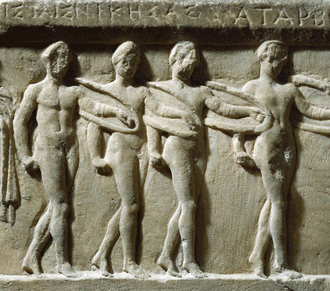
Naked men dancing the Pyrichios
After the 6th century music played a significant role in two major festivities known as “Megala Panathinea” and “Megala Dionysia” and was a main reason for Athens to hold a prominent position in terms of cultural development. During those festivities, apart from the music competitions, some very significant kinds of lyric poetry and music emerged, the most significant kind of which was the Ancient Drama.

Except being an important element in both public and private celebrations, music played an important role on unpleasant occasions and it made daily hardships more tolerable. Music was a main feature in celebrations such as weddings, banquets, social gatherings and moments of joy but also a valuable companion in everyday routine. A flute player for instance would accompany the women with his music while they were kneading, the workers during harvest, the oarsmen as well as the soldiers on their way to battle. Music was closely connected with sports and athletic games not only because they included music competitions but because the music would encourage and motivate the athlete to achieve a better performance.

The divine nature of Music

According to the ancient Greeks, music was divine as it assisted in healing both soul and body. It purified and soothed people’s souls and it inspired, encouraged and helped them relax. The above mentioned features justified the presence of Music, Asma and Orchisis in religious festivities such as the “Panathinea” held in Athens.

Music and other Art forms

Music is closely related to other sciences such as mathematics and philosophy thus it was one of the important subjects in young people’s education. Besides, its connection to the theatre and poetry was of major significance. Masterpieces of ancient Greek literature such as the Homeric epics and Ancient Tragedies were preserved thanks to music. It is an indisputable fact that music has made an invaluable contribution to the development and diversity of the Ancient Greek culture.

Sources of the Ancient Greek Music

It was believed that music was not particularly developed compared to other art forms in ancient Greece. This was due to the lack of written sources concerning ancient Greek music. Gradually, our knowledge of the role and the importance of music in ancient Greece were enriched thanks to the systematic research of all relevant sources. Thus, from lyric poetry we get lots of information concerning musical instruments while from literature or historical texts we learn a lot about prominent musicians of the time and their works.

A depiction on pots, mosaics, relieves, murals, coins and statues are an invaluable source of information concerning musical instruments and their evolution from the archaic period to the Roman times. Detailed pot decorations are a rich source of information concerning the form and shape of many instruments about which we would otherwise know nothing. Very few findings of instruments were discovered, mostly flute and rarely fragments of other instruments, such as the lyre.

Elements of ancient Greek music have also been traced in Byzantine and Traditional Greek music by researchers. The most valuable and important sources of information however, are detected and preserved in surviving scores as well as other surviving texts on harmonics such as the texts “Armonika” and “Rythmika Stichia” written by Aristoxenos Tarantinos – perhaps the most distinguished musician of the 4th century B.C.

Surviving Works

The very few surviving scores however are fragmentary, for instance some inscriptions on stones, manuscripts on papyrus etc, therefore they fail to give a full idea of the wealth and grandeur of the ancient Greek music. This music reveals the sense of moderation and harmony which are important features of the Greek civilization. All in all, sixty-one music pieces have survived to our time and if we exclude “Seikilos pillar” none of the surviving texts is complete.

Seikilos pillar
“Seikilos pillar” is the only preserved music text which was found complete. It is a small pillar which dates back to the 2nd century a.C. The poem, which is preserved and is inscribed on the pillar, talks about the true meaning of life and praises the art of quality living. It is a very small composition indicative of ancient Greek music and it is invaluable because of its uniqueness. The pillar is exhibited in the museum in Copenhagen.

The most important preserved text is the “Delphic Hymn”. It is inscribed on pillars and was found in Delphi. These invaluable extracts reveal important information about ancient Greek music. This hymn was presented during the “Pythia” in 128 BC. The pillars with the inscriptions are exhibited in the Delphi museum.

Pella curse tablet - katadesmos

The Pella curse tablet is a text written in a distinct Doric Greek idiom, found in Pella, the ancient capital of Macedon, in 1986. Ιt contains a curse or magic spell (Greek: κατάδεσμος, katadesmos) inscribed on a lead scroll, dating to first half of the 4th century BC (c. 375-350 BC). It was published in the Hellenic Dialectology Journal in 1993. It is one of four texts found until today that might represent a local dialectal form of ancient Greek in Macedonia, all of them identifiable as Doric. These confirm that a Doric Greek dialect was spoken in Macedonia, as was previously expected from the West Greek forms of names found in Macedonia. As a result, the Pella curse tablet has been forwarded as an argument that the Ancient Macedonian language was a dialect of North-Western Greek, part of the Doric dialects.


Interpretation

The tablet is also described as a "mixed curse" due to the supplicative nature of the appeal. For example the word ΕΡΗΜΑ or "abandoned" is quite common in appeals to divine powers. It is a magic spell or love charm written by a woman, possibly named Dagina (Ancient Greek: Δαγίνα), whose lover Dionysophōn (Διονυσοφῶν, gen.: Διονυσοφῶντος) is apparently about to marry Thetima (Θετίμα, "she who honors the gods"; the standard Attic Greek form is Theotimē - Θεοτίμη). She invokes "Makron and the demons" (parkattithemai makrōni kai [tois] daimosi - παρκαττίθεμαι μάκρωνι καὶ [τοῖς] δαίμοσι; in Attic, παρκαττίθεμαι is parakatatithemai - παρακατατίθεμαι) to cause Dionysophon to marry her instead of Thetima, and never to marry another woman unless she herself recovers and unrolls the scroll and for her to grow old by the side of Dionysophon.

Katadesmoi or defixiones were spells written on non-perishable material, such as lead, stone or baked clay, and were secretly buried to ensure their physical integrity, which would then guarantee the permanence of their intended effects. The language is a distinct form of North-West Greek, and the low social status of its writer, as (arguably) evidenced by her vocabulary and belief in magic, strongly hint that a unique form of West Greek was spoken by lay people in Pella at the time the tablet was written. This should not, however, be taken to indicate that only those of middling or low social status practiced magic in the Ancient Greek world: quite wealthy individuals also used lead katadesmoi (curse tablets) for love, revenge, and to bind their opponents in athletic contests.

Text and translation

Greek

1. [ΘΕΤΙ]ΜΑΣ ΚΑΙ ΔΙΟΝΥΣΟΦΩΝΤΟΣ ΤΟ ΤΕΛΟΣ ΚΑΙ ΤΟΝ ΓΑΜΟΝ ΚΑΤΑΓΡΑΦΩ ΚΑΙ ΤΑΝ ΑΛΛΑΝ ΠΑΣΑΝ ΓΥ
2. [ΝΑΙΚ]ΩΝ ΚΑΙ ΧΗΡΑΝ ΚΑΙ ΠΑΡΘΕΝΩΝ ΜΑΛΙΣΤΑ ΔΕ ΘΕΤΙΜΑΣ ΚΑΙ ΠΑΡΚΑΤΤΙΘΕΜΑΙ ΜΑΚΡΩΝΙ ΚΑΙ
3. [ΤΟΙΣ] ΔΑΙΜΟΣΙ ΚΑΙ ΟΠΟΚΑ ΕΓΟ ΤΑΥΤΑ ΔΙΕΛΕΞΑΙΜΙ ΚΑΙ ΑΝΑΓΝΟΙΗΝ ΠΑΛLΙΝ ΑΝΟΡΟΞΑΣΑ
4. [ΤΟΚΑ] ΓΑΜΑΙ ΔΙΟΝΥΣΟΦΩΝΤΑ ΠΡΟΤΕΡΟΝ ΔΕ ΜΗ ΜΗ ΓΑΡ ΛΑΒΟΙ ΑΛΛΑΝ ΓΥΝΑΙΚΑ ΑΛΛ Η ΕΜΕ
5. [ΕΜΕ Δ]Ε ΣΥΝΚΑΤΑΓΗΡΑΣΑΙ ΔΙΟΝΥΣΟΦΩΝΤΙ ΚΑΙ ΜΗΔΕΜΙΑΝ ΑΛΛΑΝ ΙΚΕΤΙΣ ΥΜΩΝ ΓΙΝΟ
6. [ΜΑΙ ΦΙΛ]ΑΝ ΟΙΚΤΙΡΕΤΕ ΔΑΙΜΟΝΕΣ ΦΙΛ[Ο]Ι ΔΑΓΙΝΑΓΑΡΙΜΕ ΦΙΛΩΝ ΠΑΝΤΩΝ ΚΑΙ ΕΡΗΜΑ ΑΛΛΑ
7. [....]Α ΦΥΛΑΣΣΕΤΕ ΕΜΙΝ Ο[Π]ΩΣ ΜΗ ΓΙΝΕΤΑΙ ΤΑ[Υ]ΤΑ ΚΑΙ ΚΑΚΑ ΚΑΚΩΣ ΘΕΤΙΜΑ ΑΠΟΛΗΤΑΙ
8. [....]ΑΛ[-].ΥΝΜ .. ΕΣΠΛΗΝ ΕΜΟΣ ΕΜΕ ΔΕ [Ε]Υ[Δ]ΑΙΜΟΝΑ ΚΑΙ ΜΑΚΑΡΙΑΝ ΓΕΝΕΣΤΑΙ
9. [-]ΤΟ[.].[-].[..]..Ε.Ε.Ω[?]Α.[.]Ε..ΜΕΓΕ [-]


English

1. Of [Theti]ma and Dionysophon the ritual wedding and the marriage I bind by a written spell, and of all other
2. wo[men], widows and maidens, but of Thetima in particular, and I entrust upon Makron* and
3. [the] demons. And that only whenever I dig out and unroll and re-read this,
4. [then] may they wed Dionysophon, but not before; and may he never wed any woman but me;
5. and may [I] grow old with Dionysophon, and no one else. I [am] your supplicant:
6. Have pity on [Phil?]a*, dear demons, for I am Dagina* of all my dear ones and abandoned.
7. But please keep this for my sake so that these events do not happen and wretched Thetima perishes miserably
8. but let me become happy and blessed.

Points of interpretation

"Makron" (line 2) is most probably the name of the dead man in whose grave the tablet was deposited. This was commonly done in the belief that the deceased would "convey" the message to the spirits of the Underworld (the "demons" in lines 3 and 6).

The missing word in line 6 between "I am your supplicant" and "have pity" (here reconstructed as [Phil?]a) is carved at the edge of the tablet and the only things we can read of it are that it is a short word that ends in-AN. "PHILAN" is a likely reconstruction, but by no means the only one possible. If true, the word "PHILAN" could equally well be either the personal name "Phila" or the feminine adjective "phila", "friend" or "dear one". In the latter case, an alternative reading of line 6 would be: "Have pity on your dear one, dear demons". In the former case, a personal name would be perfectly placed but, as the name of the person who wrote the curse is not mentioned elsewhere, it is impossible to know with certainty what the missing word is.

The word "DAGINA" (line 6) is inexplicable and previously unattested, even as a personal name. The alternative has been suggested by Dubois, that it is a misspelling, and that the writer intended to write "dapina" (the difference between Γ and Π being a single stroke). If true, this may mean that dapina is an (also unattested) Macedonian rendering of what would be written "ταπεινή", tapeinē (humble, lowly, brought low), in standard Attic. In this case the inscription reads: "for I am lowly and abandoned by all my dear ones" etc.

Dating

According to D. R. Jordan (Duke University), the tablet has been dated to the "Mid-IV [century] or slightly earlier".

Significance

The discovery of the Pella curse tablet, according to Olivier Masson, substantiates the view that the ancient Macedonian language was a form of North-West Greek:

"Yet in contrast with earlier views which made of it {i.e. Macedonian} an Aeolic dialect (O. Hoffmann compared Thessalian) we must by now think of a link with North-West Greek (Locrian, Aetolian, Phocidian, Epirote). This view is supported by the recent discovery at Pella of a curse tablet (4th cent. BC), which may well be the first 'Macedonian' text attested (provisional publication by E. Voutyras; cf. the Bulletin Epigraphique in Rev. Et. Grec. 1994, no. 413); the text includes an adverb "opoka" which is not Thessalian."

Of the same opinion is James L. O'Neil's (University of Sydney) presentation at the 2005 Conference of the Australasian Society for Classical Studies, entitled "Doric Forms in Macedonian Inscriptions" (abstract):

"A fourth‐century BC curse tablet from Pella shows word forms which are clearly Doric, but a different form of Doric from any of the west Greek dialects of areas adjoining Macedon. Three other, very brief, fourth century inscriptions are also indubitably Doric. These show that a Doric dialect was spoken in Macedon, as we would expect from the West Greek forms of Greek names found in Macedon. And yet later Macedonian inscriptions are in Koine avoiding both Doric forms and the Macedonian voicing of consonants. The native Macedonian dialect had become unsuitable for written documents."

Sources

Bloomer, Martin (2005). The Contest of Language: Before and Beyond Nationalism. University of Notre Dame Press. ISBN 0268021902.
Curbera, Jaime; Jordan, David (2002-2003). "Curse Tablets from Pydna". Greek, Roman, and Byzantine Studies (Duke University) 43 (2): 109–128. ISSN 00173916.
Damon, Cynthia; Miller, John F.; Myers, K. Sara; Courtney, Edward (2002). Vertis in usum: Studies in Honor of Edward Courtney. Walter de Gruyter. ISBN 3598777108.
Dubois, Laurent (1995). "Une Tablette de Malediction de Pella: S’Agit-il du Premier Texte Macédonien". Revue des Études Grecques 108: 190–197.
Fantuzzi, Marco; Hunter, Richard L. (2004). Tradition and Innovation in Hellenistic Poetry. Cambridge University Press. ISBN 0521835119.
Fortson, Benjamin W. (2009). Indo-European Language and Culture: An Introduction. John Wiley and Sons. ISBN 1405188960.
Gager, John G. (1999). Curse Tablets and Binding Spells from the Ancient World. Oxford University Press US. ISBN 0195134826.
Jordan, D. R. (2000). "New Greek Curse Tablets (1985–2000)". Greek, Roman, and Byzantine Studies (Duke University) 41: 5–46.
Masson, Olivier; Dubois, Laurent (2000). Onomastica Graeca Selecta. Librairie Droz. ISBN 2600004351.
Masson, Olivier (1996). Oxford Classical Dictionary. Oxford University Press.
Voutiras, Emmanuel (1998). Dionysophōntos Gamoi: Marital Life and Magic in Fourth Century Pella. J.C. Gieben. ISBN 9050634079.

Apollo and Daphne

The slime with which the earth was covered by the waters of the flood produced an excessive fertility, which called forth every variety of production, both bad and good. Among the rest, Python, an enormous serpent, crept forth, the terror of the people, and lurked in the caves of Mount Parnassus. Apollo slew him with his arrows—weapons which he had not before used against any but feeble animals, hares, wild goats, and such game. In commemoration of this illustrious conquest he instituted the Pythian games, in which the victor in feats of strength, swiftness of foot, or in the chariot race was crowned with a wreath of beech leaves; for the laurel was not yet adopted by Apollo as his own tree.

The famous statue of Apollo called the Belvedere represents the god after this victory over the serpent Python. To this Byron alludes in his “Childe Harold,” iv., 161:

“…The lord of the unerring bow,
The god of life, and poetry, and light,
The Sun, in human limbs arrayed, and brow
All radiant from his triumph in the fight.
The shaft has just been shot; the arrow bright
With an immortal’s vengeance; in his eye
And nostril, beautiful disdain, and might
And majesty flash their full lightnings by,
Developing in that one glance the Deity.”

Apollo and Daphne

Daphne was Apollo’s first love. It was not brought about by accident, but by the malice of Cupid. Apollo saw the boy playing with his bow and arrows; and being himself elated with his recent victory over Python, he said to him, “What have you to do with warlike weapons, saucy boy? Leave them for hands worthy of them. Behold the conquest I have won by means of them over the vast serpent who stretched his poisonous body over acres of the plain! Be content with your torch, child, and kindle up your flames, as you call them, where you will, but presume not to meddle with my weapons.” Venus’s boy heard these words, and rejoined, “Your arrows may strike all things else, Apollo, but mine shall strike you.” So saying, he took his stand on a rock of Parnassus, and drew from his quiver two arrows of different workmanship, one to excite love, the other to repel it. The former was of gold and sharp pointed, the latter blunt and tipped with lead. With the leaden shaft he struck the nymph Daphne, the daughter of the river god Peneus, and with the golden one Apollo, through the heart. Forthwith the god was seized with love for the maiden, and she abhorred the thought of loving. Her delight was in woodland sports and in the spoils of the chase. Many lovers sought her, but she spurned them all, ranging the woods, and taking no thought of Cupid nor of Hymen. Her father often said to her, “Daughter, you owe me a son-in-law; you owe me grandchildren.” She, hating the thought of marriage as a crime, with her beautiful face tinged all over with blushes, threw her arms around her father’s neck, and said, “Dearest father, grant me this favor, that I may always remain unmarried, like Diana.” He consented, but at the same time said, “Your own face will forbid it.”

Apollo loved her, and longed to obtain her; and he who gives oracles to all the world was not wise enough to look into his own fortunes. He saw her hair flung loose over her shoulders, and said, “If so charming in disorder, what would it be if arranged?” He saw her eyes bright as stars; he saw her lips, and was not satisfied with only seeing them. He admired her hands and arms, naked to the shoulder, and whatever was hidden from view he imagined more beautiful still. He followed her; she fled, swifter than the wind, and delayed not a moment at his entreaties. “Stay,” said he, “daughter of Peneus; I am not a foe. Do not fly me as a lamb flies the wolf, or a dove the hawk. It is for love I pursue you. You make me miserable, for fear you should fall and hurt yourself on these stones, and I should be the cause. Pray run slower, and I will follow slower. I am no clown, no rude peasant. Jupiter is my father, and I am lord of Delphos and Tenedos, and know all things, present and future. I am the god of song and the lyre. My arrows fly true to the mark; but, alas! an arrow more fatal than mine has pierced my heart! I am the god of medicine, and know the virtues of all healing plants. Alas! I suffer a malady that no balm can cure!

The nymph continued her flight, and left his plea half uttered. And even as she fled she charmed him. The wind blew her garments, and her unbound hair streamed loose behind her. The god grew impatient to find his wooings thrown away, and, sped by Cupid, gained upon her in the race. It was like a hound pursuing a hare, with open jaws ready to seize, while the feebler animal darts forward, slipping from the very grasp. So flew the god and the virgin—he on the wings of love, and she on those of fear. The pursuer is the more rapid, however, and gains upon her, and his panting breath blows upon her hair. Her strength begins to fail, and, ready to sink, she calls upon her father, the river god: “Help me, Peneus! open the earth to enclose me, or change my form, which has brought me into this danger!” Scarcely had she spoken, when a stiffness seized all her limbs; her bosom began to be enclosed in a tender bark; her hair became leaves; her arms became branches; her foot stuck fast in the ground, as a root; her face became a tree-top, retaining nothing of its former self but its beauty. Apollo stood amazed. He touched the stem, and felt the flesh tremble under the new bark. He embraced the branches, and lavished kisses on the wood. The branches shrank from his lips. “Since you cannot be my wife,” said he, “you shall assuredly be my tree. I will wear you for my crown; I will decorate with you my harp and my quiver; and when the great Roman conquerors lead up the triumphal pomp to the Capitol, you shall be woven into wreaths for their brows. And, as eternal youth is mine, you also shall be always green, and your leaf know no decay.” The nymph, now changed into a Laurel tree, bowed its head in grateful acknowledgement.

That Apollo should be the god both of music and poetry will not appear strange, but that medicine should also be assigned to his province, may. The poet Armstrong, himself a physician, thus accounts for it:

“Music exalts each joy, allays each grief,
Expels diseases, softens every pain;
And hence the wise of ancient days adored
One power of physic, melody, and song.”

The story of Apollo and Daphne is often alluded to by the poets. Waller applies it to the case of one whose amatory verses, though they did not soften the heart of his mistress, yet won for the poet wide-spread fame:

“Yet what he sung in his immortal strain,
Though unsuccessful, was not sung in vain.
All but the nymph that should redress his wrong,
Attend his passion and approve his song.
Like Phœbus thus, acquiring unsought praise,
He caught at love and filled his arms with bays.”

The following stanza from Shelley’s “Adonais” alludes to Byron’s early quarrel with the reviewers:

“The herded wolves, bold only to pursue;
The obscene ravens, clamorous o’er the dead;
The vultures, to the conqueror’s banner true,
Who feed where Desolation first has fed,
And whose wings rain contagion: how they fled,
When like Apollo, from his golden bow,
The Pythian of the age one arrow sped
And smiled! The spoilers tempt no second blow;
They fawn on the proud feet that spurn them as they go.”

Contact Form

Name

Email *

Message *

 
Copyright 2007 Melita Insula