Showing posts with label SL. Show all posts

Missing details of an Ancient World in Second LIfe (Part. 2) - "Tota Pomarium Videatur"

Salvete Omnes.
As announced in the previous post, we're already talking about historical mistakes findable on ancient lands of Second Life.
In this chapter we'll discuss about a very less considered aspect: food sold into ancient Roman markets. Venturing in any of theese land's markets, it's possible to see how offered products are almost the
same:

... Have you ever wondered if products exposed in those markets are appropriate to the historical environment surrounding it?
There's to know that a significant part of the ancient Greeks and Romans' nourishment consisted of vegetables, roots, but also wild or cultivated fruits. Fruits were a great asset in the empire, and were consumed both local and foreign resources.
As you have seen in previous pictures, these stalls are full of fruits and vegetables; some of these foods, however, were not yet known by the Romans. Let us examine a few.

- TOMATO: a native fruit from Mexico and the high valleys of the Peruvian Andes, whose name comes from "Nahuatl" (Aztecs language) and it's pronounced "tomatl or jitomate",  arrives in Europe with the return to Spain of Christopher Columbus from the Americas. At first, it's considered poisonous so it's used as an ornamental plant; in the Sixteenth century it's used for the first time in kitchen in Italy.            - CORN, whose name comes from the language spoken by the Indians from Haiti, was cultivated for a long time on the new continent. About a thousand years B.C. Hopi's ancestors (southwest of the USA) grew of considerable corn's extensions, with which they obtain a paste used to prepare the "Tortillas". It was in fact the staple food of millions of American Natives, as well as most of them attributed it a divine origin. Starting from 1600, corn gradually replaced millet's cultivations in southern Europe; it's first used as basical feeding for animals, and the first using it in the kitchen are Basque people.
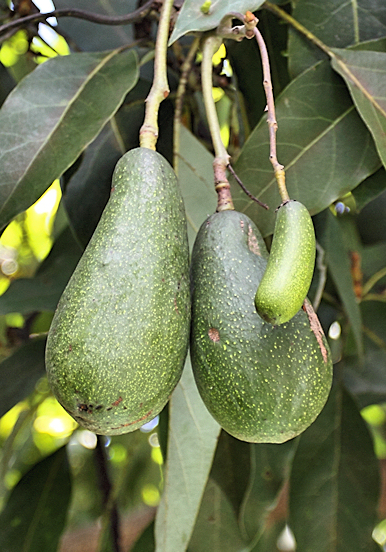
Avocados fruits
- AVOCADO, cultivated and consumed in Mexico since 5000 B.C. by the Aztecs, who called him "ahuacatl" (hence the Spanish "aguacate" or the Portuguese "abacate"). The fruit's transplant in the old continent, tried in the second half of the sixteenth century, near Rome, will prove a failure. We must wait the early 20thy century to let the avocado find its stable place in Europe.    - The PEPPER, perennial herb, is native to Central America. It was used to accompany meat dishes with red beans and corn, but was also used as an aromatic drug: the "chili", discovered by Columbus and the Spaniards and brought to Spain in the mid-sixteenth century, where it was used to enhance tomatoe's flavor. Then it's brought to Italy where it is called "coral horn", and very quickly to the rest of Europe, obtaining a spectacular success in Hungary, where it's setted up a sweeter mix: the famous "Paprika". 
- The POTATO, an herbaceous perennial plant, coming from central - southern America and imported for the first time in Europe in 1533, after Columbus' discoveries. From 1600 it becomes a common culture throughout Europe and it's used mostly for livestock nutrition. During the 1700s, known its high nutritional properties, it is consumed by all Europeans.

 In addition to pre Colombian food, we may also find kinds of products imported from Asia or Africa, not yet known by the Romans. Below we analyze some:
- The EGGPLANTS, native from India. They grown in Southeast Asia since prehistorical times and were introduced in Europe by Arabs in the early 4th century A.D.

Eggplants
- The BANANA, contrary to what might be tought, has origins in the highlands of 'South-East Asia, in Papua New Guinea, Malaysia and Philippines territories. Recent archaeological studies supports the existence of the first wild specimens of this fruit date back to 5000 BC. The first organized banana's crops dates back to 200 A.D. in China territories. In 650 A.D. Islamic conquerors exported this fruit in Palestine; later, Arab merchants brought it to almost the whole Africa. Around 1500, banana plant was introduced from Africa to the Caribbean and Central America by portugueses, then imported (only at that time) in Europe.
- The WATERMELON seems to have origins in the Kalahari desert. There are reports of first crops thanks to some Ancient Egyptian hieroglyphics dating back to 5000 years ago, when the fruit was often placed in pharaohs tombs as a means of sustenance for the afterlife. In the 10th century A.D. watermelon was cultivated in China and it was introduced in Europe only in the 13th century, with the Moors invasion.
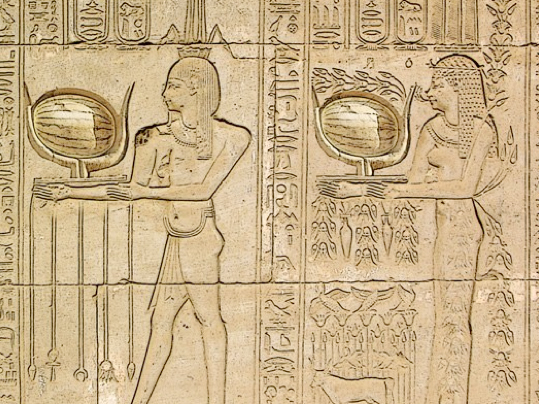
Egyptians used to place watermelons into pharaoes tombs in the way they could be fed of it in the afterlife
 So, what did ancient Romans eat?
As anybody, Romans were looking for new importing foods from every side of the world, experimenting and inventing new recipes with new ingredients. They also sought to graft and improve kinds of fruit trees, always inventing new varieties which unfortunately has been largely lost.Food for the Romans wasn't just a curiosity but a passion. There was any Roman taking care of his profession only. A great general could be a writer like Pliny, or an art collector as Maecenas, or an architect as Agrippa, or grafting fruit to invent a new product, which moreover would bear his name; for example Pliny the Younger mentions a pira (pear) Dolabelliana, (which has belonged to Publius Cornelius Dolabella 69-43 BC), or the pira Decimiana (perhaps of a certain Decinianus of the gens Claudia) or even the mala Mattiana, whose name comes from the botanical Caius Matius Calvena, known for his friendship with Julius Caesar and Cicero. The meat was rare food, at least for the poor class but also for the middle class. 
Below is a list of the most consumed foods by the Romans.
- BERRIES, considered fruits by the Romans. They include:
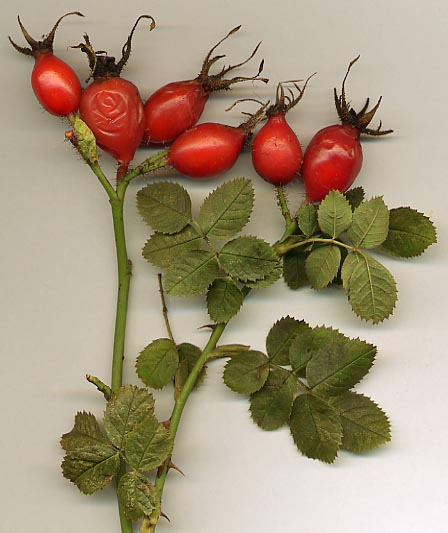
Rosehip
The ROSE (ie its rosehip), considered nutritious and healing (as rich of C vitamin). From it were obtained sauces for salty foods, sweets or velvety to eat alone or to garnishing cakes, or dissolved in water with other flower essences to make fresh drinks; the petals, however, combined with honey and other essences could become a fine food.
The BLACKBERRY (Rubus), used with honey and essences for bittersweet kitchens;
The RASPBERRY (Rubus), similar to blackberry as flavor but more acidic, was very used for fresheners or to stuff roasted sprayed with red and full-bodied wines;
 
The WILD PRUGNOLO or PRUNO (prunus), a spontaneous thorny plant of Europe, Asia, and North Africa; its sour taste and aromatic fruits were much appreciated by the Romans when eaten fresh or cooked with honey; by the same fruits was made a full of tannin vinegar (used instead of lemon, which was known but used as a medicine) that gave a sour taste to the foods;
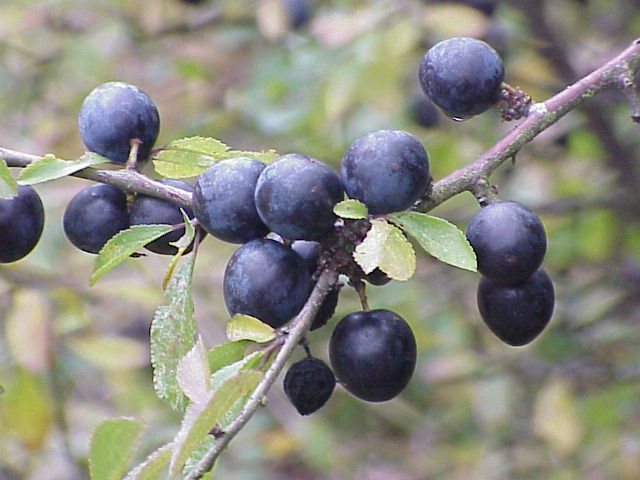
Prunus
The STRAWBERRY (Fragaria), particularly suitable for volcanic territories (as the Italic soil was), was much appreciated by the Romans; wealthy people owned it in crops, however it was not so difficult to find it in the undergrowth;
The PINE (Pinus), or the Pine berries (from whose white bark was also extracted a little tasty but nutritious meal), which were first used as dry fruit, to flavor meat or fish, or were mixed with honey or boiling molasses to make cakes;
the ACORN, the oak's fruit, from which was made a flour, after having purified it from tannin;

Corniola
 The CORNIOLA (corna), a red cherry-like fruit, from the aromatic, harsh and bitter flavor; it was first used to feed pigs, then he came introduced in Roman cooking; marinated in salt water for a certain period and seasoned with bay leaves and fennel seeds, was used to season the game's filling or red meat in general, or to prepare bitter-sweet sauces, or more was made a syrup diluted with water and served as a sorbet, to prepare the diners' stomach to the new dishes. It was also used as an ingredient to prepare puddings, uniting him to less acidic fruits such as pears, apples, and elder;
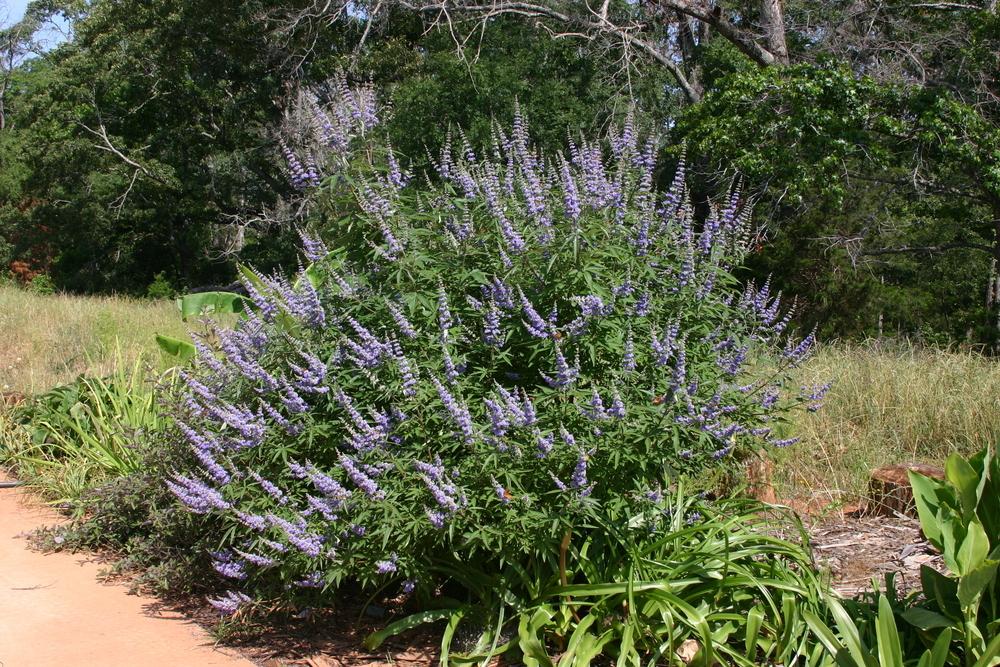
JUNIPER berries, similar to plums for their small rounded appearance, they were collected in autumn and left to dry in a ventilated place to then collect them in pots and use them throughout the year; They were used in roasts and in very tasty and spicy fillings, with fennel and thyme, and were good for strong and dry red wines;The CHASTE TREE (Vitex agnus-castus), a plant that usually grows on all Mediterranean and West Asia coasts, until Persia. Its bitter tasted fruits were eaten by Roman gourmets, combined with jujube or honey, or were used in desserts and soups, for its slightly spicy flavor.
- The DRY FRUIT, among which we list:
  The WALNUT (Juglans regia), plans of the Eastern Mediterranean, also known to the 
  Greeks;  the Romans cultivated it since the time of kings, using it in different ways like  
  throwing nuts during weddings or in the secret rites of Diana Caria monastery's priestess
  in Benevento, where the walnut tree's fruit was sacred. Varro, Pliny and Dioscorides talked 
  about walnuts.
  The ALMOND (amygdala), native to the Western temperate Asia, eaten by Greeks and 
  Romans, both sweet and bitter, it was believed that eaten before drinking wine could 
  prevent the thrill; used in different traditional Mediterranean kitchens like those of Sicily  
  and Puglia,  it accompanied sweet and savory dishes, or was served along with luscious 
  fruits;
  The PISTACHIOS (pistacia), came from the East, were mixed with some Roman kitchen 
  dishes;
- FLESHY FRUIT, among which we mention:
  The FIG (ficus), native from Caria in Asia Minor; much appreciated if eaten cool or dry, 
  it formed the most used occasional nourishment during the day; especially in Campania, 
  the Romans were very fond of eating bread and figs; it was considered also sacred,  
  because when unriped it produced a liquid similar to milk, so sacred to the goddess 
  Rumina, ancient pre-Roman and Roman goddess;
  the APPLE (malum), not a fruit but a knob, where the real fruit is the core, while the
  edible part is the core's receptacle; Romans ate it both raw and cooked, sweetened with  
  honey or molasses; It was mainly used by lower classes for the ease in cultivating and 
  storing it;
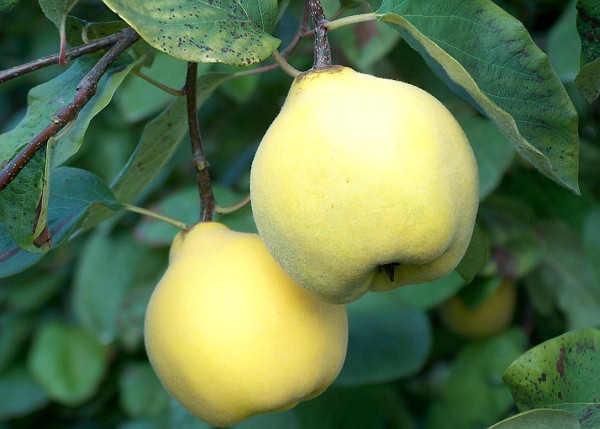
Malum Cotoneum
  The APPLE QUINCE (malum     
  cotoneum), considered by 
  Romans a sacred fruit to  
  Aphrodite;  there were  
  different qualities but few 
  were  suitable to be eaten raw;
  they were generally boiled  
  with honey or molasses and  
  combined with almonds and 
  walnuts, or was made  a kind 
  of jam which were
  manifactured sweets and  
  cookies;
  THE MALUM MUSTERIUM, made from a 
  quince graft with common apple, obtaining a
  variety very appreciated by the Romans; tasting slightly sour but compact, it had the
  advantage to keeping for a long time so was used as dried fruit or as an interlude or to
  manufacture sweets;
  The PEAR (pirum), present among the Romans in several different quality; such as the 
  apple, it  was eaten raw and cooked and was useful to make special dishes; pears could 
  be well preserved and dried in the sun and eaten boiled in wine.
  The MEDLAR (Mespilus germanica), known by the Romans after the Cato period and were 

  native from Germany and not Japan; differently than japaneses, those eaten by the 
  Romans  were sour and hard, in fact before being eaten they were sweetened by storing 
  them in a dry and well ventilated area;
Sorbs
The SORBS, mentioned by Hippocrates as an astringent medicine; their pulp was dried and sometimes mixed with 
wheat flour, to  make bread or tasty buns;
PEACH (persicum), native to China, spread throughout the Mediterranean hollow thanks to Alexander the Great and arrived in Rome in the 1st century D.C., it was first a reserved fruit for the riches, then it was spread out to all the tables;
The APRICOT (Prunus), originally from northeastern China to the Russian border and discovered by Alexander the Great in his travels in Persia, were the Romans who brang it not only in Italy but also in Greece, between 70-60 B.C.; often it was dried in the sun to enjoy it in those long periods when production was off;
The POMEGRANATE, considered native from South West Asia, has been cultivated in the Caucasus since ancient times and was spread by Phoenicians and Greeks in their colonies;
Lotus (Jujube)
The JUJUBES (lotus), native to Asia but already present in Italy since the time of Romans, were eaten fresh or withered, the withered one was often drowned in wine (making the so-called jujube' stock);
The PLUM (cereal prunum), known in many varieties, was anciently used and widely practiced; Greek doctors suggested to cook it with honey, for its laxative properties;
CHERRY (Prunus avium), whose first trees were imported to Rome in 72 B.C. by Lucius Licinius Lucullus after the firm of Mithridates;
The DATE (palmulae), used as exotic fruit imported from abroad;
The OLIVE rarely eaten fresh as a dessert fruit, while at times was eaten the fruit of persea, which was a plant still not well identified;

The CAROB, initially considered harmful for health, fell within recipts of some sweets where it was combined as powder with honey and crushed nuts, drawing an exquisite flavor;
The GRAPE, for the ancients one of the main dessert fruit; there were several varieties and were very appreciated both fresh and dried;
The ELDER, eaten as a fruit but with a special treatment;
The ARBUTUS, not so used in Rome except to make sauces and desserts; 
The CHESTNUT, known under different names, was eaten boiled, roasted, dried, cooked with fennel or in puree or soup; chestnuts also drew the flour;

And last, but not least, we find the CUCURBITS, including PUMPKIN, the CUCUMBER and POPON, native from Iran and used since the 5th century. B.C.

However, there is a fruit which recent discoveries has created a light "quid pro quo" (misunderstandings). In the Museum of Palazzo Massimo alle Terme in Rome, you can make an incredible discovery: at the second-floor, in the classic world's  frescoes, mosaics and stucco's gallery, there is a mosaic dated to the early 1st century A.D., showing a fruit basket containing from left, some figs, quince, a bunch of black grapes, pomegranates and an impossible food: a pineapple. The presence of this fruit has left speechless, because the Pineapple sativus plants, which belongs to the bromeliad family, arrived in the old Continent only after the Christopher Columbus' voyages. So before the American discovery, Romans could not know this tropical fruit.
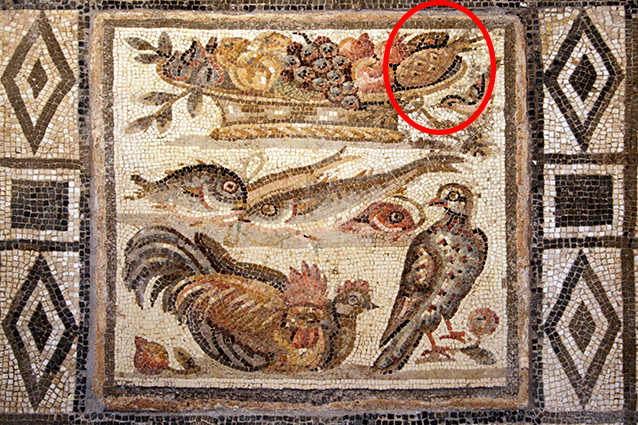
Actually it is not the first time a similar figure may be seen on a Roman work; a fresco found in the ephebe house in Pompeii shows a pineapple and a Roman statue, preserved in Geneva, representing a child holding a pineapple for its crest.

Everything suggests that Romans knew this fruit since the 1st century A.D. and this mystery has pioneered several hypotheses, including one that Romans could have arrived in America. Myth bustered right away, as the innumerable sources doesn't minimally referr to the New Continent, as it is certain their logistic capabilities would not allow them to reach so far places and above all beign able to stow fresh food for too long periods. It 's more likely that Romans have imported this fruit from West Africa, where pineapple was grown.So, let's hope this "virtual excursus" between the Roman food has made clear about ancients culinary habits. For a virtual roleplay land where knowing how to role play is the main pourpose, a touch of authenticity in these things would not hurt, indeed the game would result more interesting; in this sense builders and marketplace sellers play a main role, as people trust them and their creations to make spectacular and also authentic backgrounds. 
I wish you all a nice Ancient SL and see you to the next post!

 Hermes (a.k.a. Tonio Renfold).

Ancient Heritage on virtual grids: missing details of Ancient Worlds in Second Life (Part 1)

The metaverse is a really interesting world, which offers various ways to concretely represent what we can't bring in the real world. Between the many popular activities, both on the web (such as forums, blogs, social networks, etc ..) and in virtual grids like Second Life, we find the Roleplay, proposed in different scenarios: from fantasy to sci-fi, or those inspired by fictions and films, but also based on historical events or settings.
And it is right in historical scenarios that we focus our attention.
In the virtual world of Second Life, these scenarios are identified as belonging to the so called AW (acronymus for Ancient World), whose historical periods vary by Hellenistic age to the Victorian, through the various Mediterranean and Mesopotamian settings, until Northeast European lands.
To make the game more intriguing and compelling, some lands  got insipired by mythological stories of the periods which they belong; while others are based on stories and characters of famous Hollywood films (such as Cleopatra, played by Liz Taylor, The Gladiator of Russell Crowe, 300 of Zack Shneider or the famous TV saga licensed HBO, Spartacus).
 Sometimes theese stories are so intriguing and surreal that often fall into banality, representing a very far past from what has been handed down by our ancestors and from what has been discovered over the centuries by many historians and professionists.


Getting more in details, the purpose of this page is just to keep clear the many historical inconsistencies foundable in theese lands (as in those films they are inspired at), paying particular attention to the many historic Roman lands existed in the metaverse.
Want to know more? Then be patient and let's wait to read th next topic. For now "Valete Omnes".

Fighting Lag, a Small Tutorial II

Bandwidth. You would normally set it as high as possible.
However, if you set it to the limit of the bandwidth, that your ISP supports, you will experience the danger of packet loss (amount of lost data on the connection, which must be redelivered) and lost packets can not be redelivered in an acceptable time.
To set this value very low, will set your packet loss to zero, but your SL will become slower. You should set this value to about 50 - 70 % of the available bandwidth. For 2.27 Mb per second. With the factor 1000 that are 2270 kbps, so normally you are in SL with half of that speed and set it to 1000. For fighting reduce it to 500. The connection would still work with 1000, but when all fighters (and spectators) use the sim server to the max, they all suffer from server lag again. So, for fighting, all will be happy with 500 kbps. If your connection is slower, try a setting of 50-70 %. If you experience packet loss, set it lower, if you run with a packet loss of 0, you might increase this value.

Recommended settings for Cache Size: 200 MB or a bit more. Higher settings tend to decrease performance after a while, when the cache slowly works less efficient.
Clearing the cache will speed the cache operation, but if you do that shortly before a fight, take a bit of time to wander around in the arena to have all textures around loaded into the cache before you fight.

Press CRTL - Shift - 1 and see the window in the upper right. You will see the bar for FPS, frames per second, which shows, how many frames your computer can generate in one second. Values between 20 and 30 are normal movie or tv speed, below 20 you will notice the low rate and below 10 you should normally not play and definitely not fight.

The FPS rate also shows, how many of your keystrokes will be delivered to the server, you can hit the arrow keys like a madman, at a FPS below 10 not many of them will hit your opponent, your computer is busy with creating the screens, no time to transfer your actions.

Next bar is Bandwidth. Will be quite low, when nothing happens and you don't move. But turn around or run, and the value will change dramatically. Here you can see, what your action in SL causes in means of data transfer via the internet.

And on third place you see the percentage for packet loss. Get to 0.0 as close as possible. If you never get numbers here, you might want to increase the bandwidth speed and have more fun in SL, but change to 500 again for fighting.

Viewer settings can be accessed via the menu (Edit - Preferences) or by the shortcut CRTL - P. Open the folder "Graphics" to control all the settings that control how SL appears on your screen. You will normally have checked to run SL in a window. In the quality bar select Low or Mid and also check "Custom".

This will open the lower part of the settings, where you should do the following settings:
- uncheck Bump and Shiney
- uncheck Basic Shaders
- uncheck Avatar Impostors

Draw Distance slider bar 64m. Definitely the setting that helps most. You might want to set it higher in a raid or war, when you use range weapons (sniper, bows, …), but you should not go beyond 128 here.

Max. Particle Count = Here you can easily switch off all particles. Default setting is 4096 here, you should also set this to 1000-2000 for normal use, or to about 500 if you really want to see the blood particles in a fight instead of winning the tourney.

Post Process Quality = low, all the way down

Mesh Detail:
Objects: 1/4th the slider bar, or less
Flexiprims: 1/4th the slider bar, or less
Trees: 0, all the way down, trees are not important for a fight
Avatars: 1/4th the slider bar or 1/2 if you computer and graphics card allow you to see your opponent a bit better
Terrain: 0, all the way down

Lighting detail: Sun and Moon only
Terain Detail: low (I know, that does not look good, but you want to win, or?)

Draw distance: Well, the most important slide bar here is the draw distance. You will experience that even in quite empty sims, you will get FPS rates of only 10-20 when you set the draw distance too big. Remember, if you double the draw distance, the area of the circle that you now see, increases on factor 4! This means, doubling the draw distance will cause 4 times the data of prims to be transferred and 4 times the textures. Also, if you approach or go beyond distanced of 200 m, not only one sim server has to transfer the data, but more of them (sims only are squares of 256 m). If you go up to 512 m, more than 25 sim servers might have to do transfer data for you, which also causes a lot of data transfer between them, server communication that causes more lag. So also in normal SL use, be careful with this setting. You mostly never need to look that far, and you make a lot of servers working for you and causing lag for all others on those sims.

Bump Mapping, Basic shaders and Nearby local lights. They might cause nice effects, when used in builds and for light. But most builders do not use them, so you mostly see nothing more with those checkboxes clicked. These are normally set to on by the default SL settings, even in the lower quality settings. But they really cause lag, as every prim face has to be checked and evaluated by the physics engine several times.

You might want to try the other settings outside fights. Feel free to set SL in a way that is fun to use and not causing too much lag. It's all up to you on this folder of the viewer settings.

Graphics card and CPU. Two elements of your computer are very important for little lag. One of them is the graphics card and especially their drivers. Check the internet regularly for new drivers of your card. Drivers that are about half a year of age might cause problems for you. If you own an old computer and think of upgrading, very often a change of the CPU causes better results than a change of the graphics card. SL is an application that uses the CPU to the limits.

Running other applications: Forget it. You cannot download videos from the net and with a fight at the same time.

Think of disabling video and audio streams and voice for your fights. All these might take different ways in the internet, but they go over your internet connection and take some from the bandwidth that you need to win the fight.

Rebooting your computer before starting SL can help get better performance

Use the deruthing device, an object, that brings you into some height for some seconds, which clears your graphics cache and makes your graphics card work better. Many of the older fighters have them (blue cylinder or yellow cone) and will happily give you one.

To clear the internal ram caching on your harddisk, it helps to minimize the SL window for about 5 to 10 seconds. After that SL will run more smoothly. Also great to be done before a fight.

Defragment your hard drive occasionally.

Lag occurs most when:
- Your Draw Distance is too high
- There are many physical (physics-enabled) objects nearby
- There is a large group of people nearby
- You are moving (and therefore loading new geometry, textures, and sounds)
- You or other people are playing sounds or animations
- When many objects are moving around nearby
- You have "fancy" graphics features enabled (Anisotropic Filtering, Ripple Water, etc)
- The people that built the sim used big textures


Fighting Lag, a Small Tutorial I

We will always have lag, cause SL is different from all other "games", as it provides great creativity and a dynamic scenery, that can be changed by everybody at any time. What many need is a tutorial about fighting lag for fighting better. We all can do a lot to make each event, each duel, each tournament fun for all, the warriors and the spectators.

Lag happens:
~ On the server that runs the sim you are on and on the servers that run the sims next to that one.

~ On your computer, which has to calculate a lot of what you see on the screen.

~ On the way between the server and your computer (and back).

Very often people blame SL for lag, while they do anything on their computers to increase the problem … for themselves and for others. If lag happens, and you cause lag, all other residents around you will also have to bear the consequences. Even if lag in on the side of your computer, the others will feel, that you need more data than your computer can take to perform lag free. When we fight, we want as little lag as possible. So let us first start to see the settings that will help to reduce lag and to fight better and then explain those controls, and why they work. We will also add some hints on how to build for little lag and talk about the controls that show you the situation.

For fighting:
The nicer you want to see the fight, the more you will be defeated and die. The more you make your avatar and your screen look simple, the more you will win.

If you fight or participate or visit an event:
- Reduce prims of your hair
- Reduce prims of your shoes
- Don't come with furry avatars that need hundreds of prims for their hair
- Reduce the prims of your clothing.
- Switch off or better detach AOs
- Never come with a poofer or other particle scripts
- Reduce the use of radars, do not use scanners or gadgets with sensors or listeners
- Do not move, if you are not a participant. Best of all: sit.
- Do not TP into the crowd, TP outside and walk to the event.
- Use camera controls to watch something, don't go there, when the sim is full of avas
- Best would be to fight naked and bald. The less prims you wear, the less data has to be transmitted, the quicker will be the reaction of the server on your keystrokes, the more hits you will place
Find a fighting gear that is acceptable, but uses only few prims.
If you chose to fight with flexi hair, with a multi prim kilt or lots of equipment attached, that might look good, but will take you some hp for not reacting as quick as you could.

What is an avatar?
Shape, skin, animations, clothing, hair. The shape might count as some complex prim, the skin is an assembly of textures. Animations are like little vids, everything else consists of prims and textures. Plus, there are scripts and programs, scripts that run on the server and part of them on your computer, and programs, also on the server and your computer, that calculate positions, collisions, sound starts and the way, each particle texture has to take its way across your screen. Let us quickly add it up: An avatar might have 100 prims in their hair, 100 in their shoes, 100 in their clothing and 100 in their body parts and weapons etc. Makes a sum of 400 prims, all being described on the server. All these prims have a number of faces (a box has 6), let us estimate an average of 5, that means 2000 faces on these prims, 10% of them might have a unique texture, which would sum up to 200 textures for one avatar. Plus: there are animations, which count as little vids. If you come into a sim and have a nice landing animation, a nice stand up animation and a nice walk animation, that makes 3 extra ones that must be laoded, when you appear.

If you think of a prim as a data amount of 2 lines of text, you can count an avatar like a website of 800 lines of text with 200 pictures within and 3 little movies. How quick do you expect such a website to load? Well, SL can do it, much quicker than you expect from a website.

Also remember:
When you appear on a sim with 20 avatars already being there, that sim server has to send your data to all of them 20 users and also has to send their data (20) to your computer. So, in the second that you appear on a sim, the server will have the request like sending 40 huge websites in the next second … extra, besides the transfer that is needed to act in the sim. Additionally, all those computers have to calculate your appearance, your moves, your poofer and the way of all the many textures your poofer sends out. So, imagine: 40 websites, each with 800 lines of text, 3 vids and 200 pictures will have to be transferred by the sim server, when your avatar appears in the middle of the crowd. This explains, why the fighters in a tournament might go and have a coffee break, when a nice new avatar with great hair, nice shoes and lots of fur or clothing and a great poofer and AO appears teleporting into the arena. Imagining the huge amount of data that only has to be transferred on your arrival (we still don't talk about you moving), there are some easy hints, how you can help to reduce lag on events and tournaments:

Want to find out, if your avatar causes more lag than the others? Activate the "Advanced" menu. If it's not there, press ALT - CRTL - D and you will have it available. In that menu find:
Rendering - Info Displays - Avatar Rendering Cost

Avatar Rendering Cost (ARC) is a number that adds up the amount of bandwidth needed for the prims, textures, blings etc. of an avatar and displays them above the head. Green numbers are ok, they become red, when you attach many prims or weapons. Spectators on an event should never have red ARC numbers, but just look at it on the next party or tournament that you visit. You will find the causes for lag. Take some time to find our, which piece of clothing, which weapon, which textures or skins do more for the ARC and which are better. ARC is a very useful information, if you are interested to reduce lag caused by your avatar.

BTW, for cheaters:
In a war it might be useful for cheaters to activate the ARC display. They are to be seen in so much greater distance than the tags or the meter displays. Avatars cannot hide in a war, when you activate the ARC display. But think of it: is it fair to make use of it in a fight?

Viewer settings can be accessed via the menu (Edit - Preferences) or by the shortcut CRTL - P. Open the folder "Network" to control bandwidth and cash, which means to control network lag.

Bandwidth
Recommended settings for Maximum Bandwidth: not more than 500 kbps for fighting.
(If your connection only supports less than 1 Mbps, read below, set it to half of your bandwidth)

Cache
Set it to 200 MB, or a bit more, if you have a real good computer.


Contact Form

Name

Email *

Message *

 
Copyright 2007 Melita Insula