
As announced in the previous post, we're already talking about historical mistakes findable on ancient lands of Second Life.
In this chapter we'll discuss about a very less considered aspect: food sold into ancient Roman markets. Venturing in any of theese land's markets, it's possible to see how offered products are almost the same:


... Have you ever wondered if products exposed in those markets are appropriate to the historical environment surrounding it?
There's to know that a significant part of the ancient Greeks and Romans' nourishment consisted of vegetables, roots, but also wild or cultivated fruits. Fruits were a great asset in the empire, and were consumed both local and foreign resources.
As you have seen in previous pictures, these stalls are full of fruits and vegetables; some of these foods, however, were not yet known by the Romans. Let us examine a few.
 - TOMATO: a native fruit from Mexico and the high valleys of the Peruvian Andes, whose name comes from "Nahuatl" (Aztecs language) and it's pronounced "tomatl or jitomate", arrives in Europe with the return to Spain of Christopher Columbus from the Americas. At first, it's considered poisonous so it's used as an ornamental plant; in the Sixteenth century it's used for the first time in kitchen in Italy. - CORN, whose name comes from the language spoken by the Indians from Haiti, was cultivated for a long time on the new continent. About a thousand years B.C. Hopi's ancestors (southwest of the USA) grew of considerable corn's extensions, with which they obtain a paste used to prepare the "Tortillas". It was in fact the staple food of millions of American Natives, as well as most of them attributed it a divine origin. Starting from 1600, corn gradually replaced millet's cultivations in southern Europe; it's first used as basical feeding for animals, and the first using it in the kitchen are Basque people.
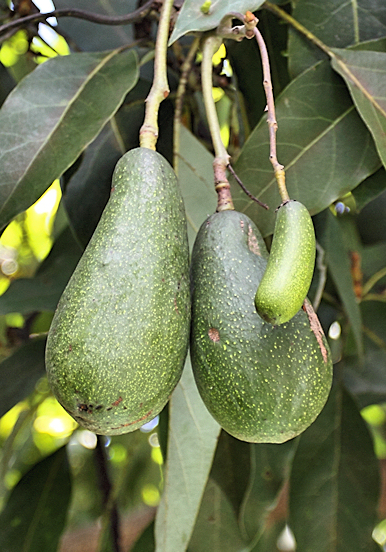 |
| Avocados fruits |
- The POTATO, an herbaceous perennial plant, coming from central - southern America and imported for the first time in Europe in 1533, after Columbus' discoveries. From 1600 it becomes a common culture throughout Europe and it's used mostly for livestock nutrition. During the 1700s, known its high nutritional properties, it is consumed by all Europeans.
In addition to pre Colombian food, we may also find kinds of products imported from Asia or Africa, not yet known by the Romans. Below we analyze some:
- The EGGPLANTS, native from India. They grown in Southeast Asia since prehistorical times and were introduced in Europe by Arabs in the early 4th century A.D.
 | ||
| Eggplants |
- The WATERMELON seems to have origins in the Kalahari desert. There are reports of first crops thanks to some Ancient Egyptian hieroglyphics dating back to 5000 years ago, when the fruit was often placed in pharaohs tombs as a means of sustenance for the afterlife. In the 10th century A.D. watermelon was cultivated in China and it was introduced in Europe only in the 13th century, with the Moors invasion.
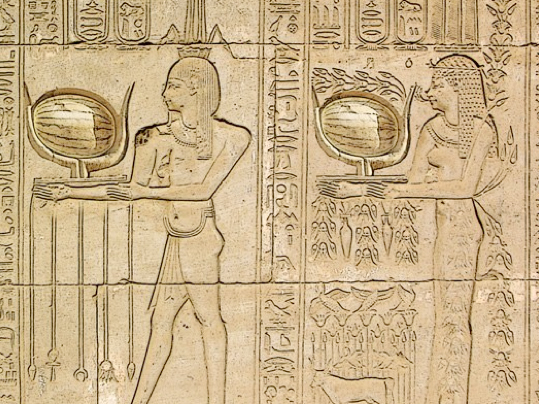 |
| Egyptians used to place watermelons into pharaoes tombs in the way they could be fed of it in the afterlife |
As anybody, Romans were looking for new importing foods from every side of the world, experimenting and inventing new recipes with new ingredients. They also sought to graft and improve kinds of fruit trees, always inventing new varieties which unfortunately has been largely lost.Food for the Romans wasn't just a curiosity but a passion. There was any Roman taking care of his profession only. A great general could be a writer like Pliny, or an art collector as Maecenas, or an architect as Agrippa, or grafting fruit to invent a new product, which moreover would bear his name; for example Pliny the Younger mentions a pira (pear) Dolabelliana, (which has belonged to Publius Cornelius Dolabella 69-43 BC), or the pira Decimiana (perhaps of a certain Decinianus of the gens Claudia) or even the mala Mattiana, whose name comes from the botanical Caius Matius Calvena, known for his friendship with Julius Caesar and Cicero. The meat was rare food, at least for the poor class but also for the middle class.
Below is a list of the most consumed foods by the Romans.
- BERRIES, considered fruits by the Romans. They include:
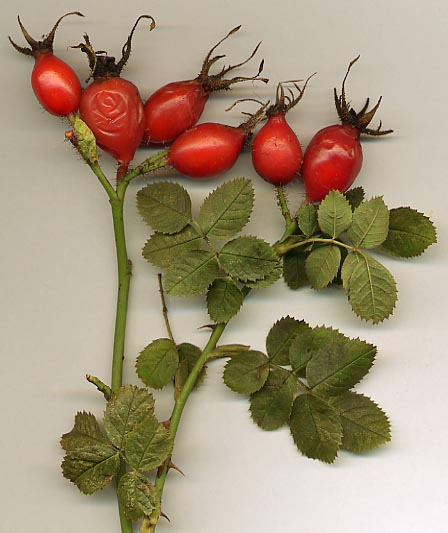 |
| Rosehip |
The BLACKBERRY (Rubus), used with honey and essences for bittersweet kitchens;
The RASPBERRY (Rubus), similar to blackberry as flavor but more acidic, was very used for fresheners or to stuff roasted sprayed with red and full-bodied wines;
The WILD PRUGNOLO or PRUNO (prunus), a spontaneous thorny plant of Europe, Asia, and North Africa; its sour taste and aromatic fruits were much appreciated by the Romans when eaten fresh or cooked with honey; by the same fruits was made a full of tannin vinegar (used instead of lemon, which was known but used as a medicine) that gave a sour taste to the foods;
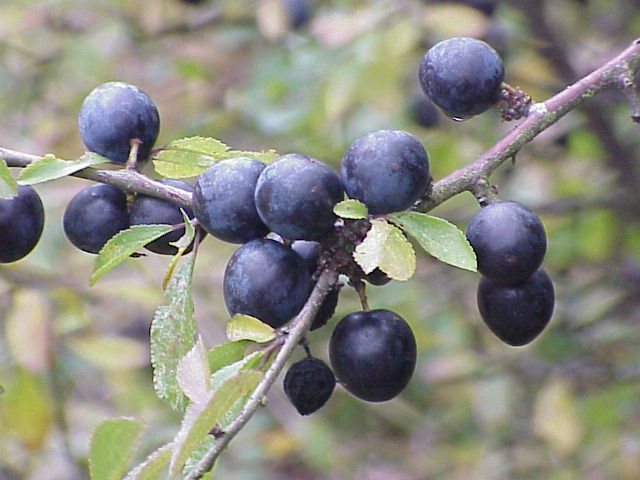 |
| Prunus |
The PINE (Pinus), or the Pine berries (from whose white bark was also extracted a little tasty but nutritious meal), which were first used as dry fruit, to flavor meat or fish, or were mixed with honey or boiling molasses to make cakes;
the ACORN, the oak's fruit, from which was made a flour, after having purified it from tannin;
 | |
| Corniola |
JUNIPER berries, similar to plums for their small rounded appearance, they were collected in autumn and left to dry in a ventilated place to then collect them in pots and use them throughout the year; They were used in roasts and in very tasty and spicy fillings, with fennel and thyme, and were good for strong and dry red wines;The CHASTE TREE (Vitex agnus-castus), a plant that usually grows on all Mediterranean and West Asia coasts, until Persia. Its bitter tasted fruits were eaten by Roman gourmets, combined with jujube or honey, or were used in desserts and soups, for its slightly spicy flavor.

The WALNUT (Juglans regia), plans of the Eastern Mediterranean, also known to the
Greeks; the Romans cultivated it since the time of kings, using it in different ways like
throwing nuts during weddings or in the secret rites of Diana Caria monastery's priestess
in Benevento, where the walnut tree's fruit was sacred. Varro, Pliny and Dioscorides talked
about walnuts.
The ALMOND (amygdala), native to the Western temperate Asia, eaten by Greeks and
Romans, both sweet and bitter, it was believed that eaten before drinking wine could
prevent the thrill; used in different traditional Mediterranean kitchens like those of Sicily
and Puglia, it accompanied sweet and savory dishes, or was served along with luscious
fruits;
The PISTACHIOS (pistacia), came from the East, were mixed with some Roman kitchen
dishes;
- FLESHY FRUIT, among which we mention:
The FIG (ficus), native from Caria in Asia Minor; much appreciated if eaten cool or dry,
it formed the most used occasional nourishment during the day; especially in Campania,
the Romans were very fond of eating bread and figs; it was considered also sacred,
because when unriped it produced a liquid similar to milk, so sacred to the goddess
Rumina, ancient pre-Roman and Roman goddess;
the APPLE (malum), not a fruit but a knob, where the real fruit is the core, while the
edible part is the core's receptacle; Romans ate it both raw and cooked, sweetened with
honey or molasses; It was mainly used by lower classes for the ease in cultivating and
storing it;
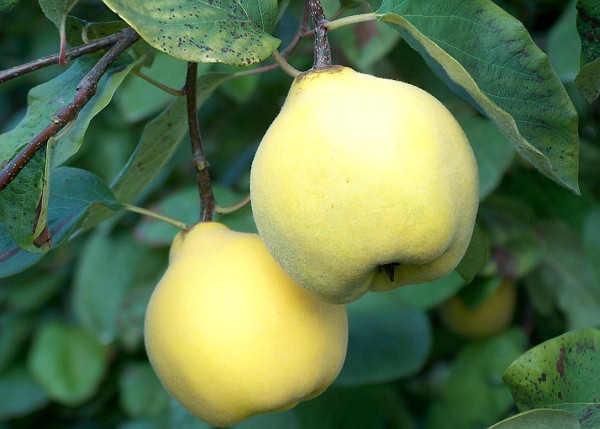 |
| Malum Cotoneum |
cotoneum), considered by
Romans a sacred fruit to
Aphrodite; there were
different qualities but few
were suitable to be eaten raw;
they were generally boiled
with honey or molasses and
combined with almonds and
walnuts, or was made a kind
of jam which were
manifactured sweets and
cookies;
THE MALUM MUSTERIUM, made from a
quince graft with common apple, obtaining a
variety very appreciated by the Romans; tasting slightly sour but compact, it had the
advantage to keeping for a long time so was used as dried fruit or as an interlude or to
manufacture sweets;
The PEAR (pirum), present among the Romans in several different quality; such as the
apple, it was eaten raw and cooked and was useful to make special dishes; pears could
be well preserved and dried in the sun and eaten boiled in wine.
The MEDLAR (Mespilus germanica), known by the Romans after the Cato period and were
native from Germany and not Japan; differently than japaneses, those eaten by the
Romans were sour and hard, in fact before being eaten they were sweetened by storing
them in a dry and well ventilated area;
 |
| Sorbs |
wheat flour, to make bread or tasty buns;
PEACH (persicum), native to China, spread throughout the Mediterranean hollow thanks to Alexander the Great and arrived in Rome in the 1st century D.C., it was first a reserved fruit for the riches, then it was spread out to all the tables;
The APRICOT (Prunus), originally from northeastern China to the Russian border and discovered by Alexander the Great in his travels in Persia, were the Romans who brang it not only in Italy but also in Greece, between 70-60 B.C.; often it was dried in the sun to enjoy it in those long periods when production was off;
The POMEGRANATE, considered native from South West Asia, has been cultivated in the Caucasus since ancient times and was spread by Phoenicians and Greeks in their colonies;
 |
| Lotus (Jujube) |
The PLUM (cereal prunum), known in many varieties, was anciently used and widely practiced; Greek doctors suggested to cook it with honey, for its laxative properties;
CHERRY (Prunus avium), whose first trees were imported to Rome in 72 B.C. by Lucius Licinius Lucullus after the firm of Mithridates;
The DATE (palmulae), used as exotic fruit imported from abroad;
The OLIVE rarely eaten fresh as a dessert fruit, while at times was eaten the fruit of persea, which was a plant still not well identified;
The CAROB, initially considered harmful for health, fell within recipts of some sweets where it was combined as powder with honey and crushed nuts, drawing an exquisite flavor;
The GRAPE, for the ancients one of the main dessert fruit; there were several varieties and were very appreciated both fresh and dried;
The ELDER, eaten as a fruit but with a special treatment;
The ARBUTUS, not so used in Rome except to make sauces and desserts;
The CHESTNUT, known under different names, was eaten boiled, roasted, dried, cooked with fennel or in puree or soup; chestnuts also drew the flour;
And last, but not least, we find the CUCURBITS, including PUMPKIN, the CUCUMBER and POPON, native from Iran and used since the 5th century. B.C.
However, there is a fruit which recent discoveries has created a light "quid pro quo" (misunderstandings). In the Museum of Palazzo Massimo alle Terme in Rome, you can make an incredible discovery: at the second-floor, in the classic world's frescoes, mosaics and stucco's gallery, there is a mosaic dated to the early 1st century A.D., showing a fruit basket containing from left, some figs, quince, a bunch of black grapes, pomegranates and an impossible food: a pineapple. The presence of this fruit has left speechless, because the Pineapple sativus plants, which belongs to the bromeliad family, arrived in the old Continent only after the Christopher Columbus' voyages. So before the American discovery, Romans could not know this tropical fruit.
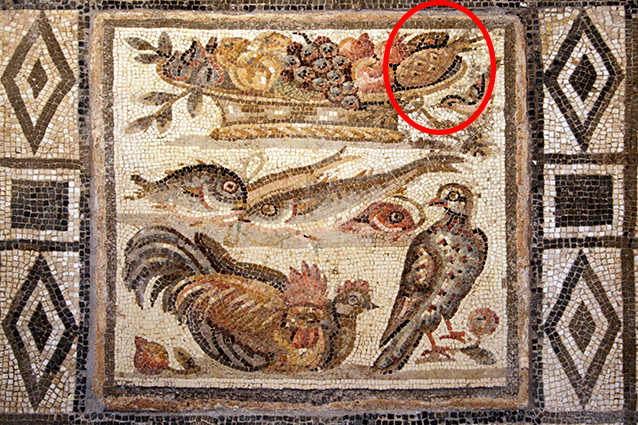
Actually it is not the first time a similar figure may be seen on a Roman work; a fresco found in the ephebe house in Pompeii shows a pineapple and a Roman statue, preserved in Geneva, representing a child holding a pineapple for its crest.

I wish you all a nice Ancient SL and see you to the next post!
Hermes (a.k.a. Tonio Renfold).


 Entries


